
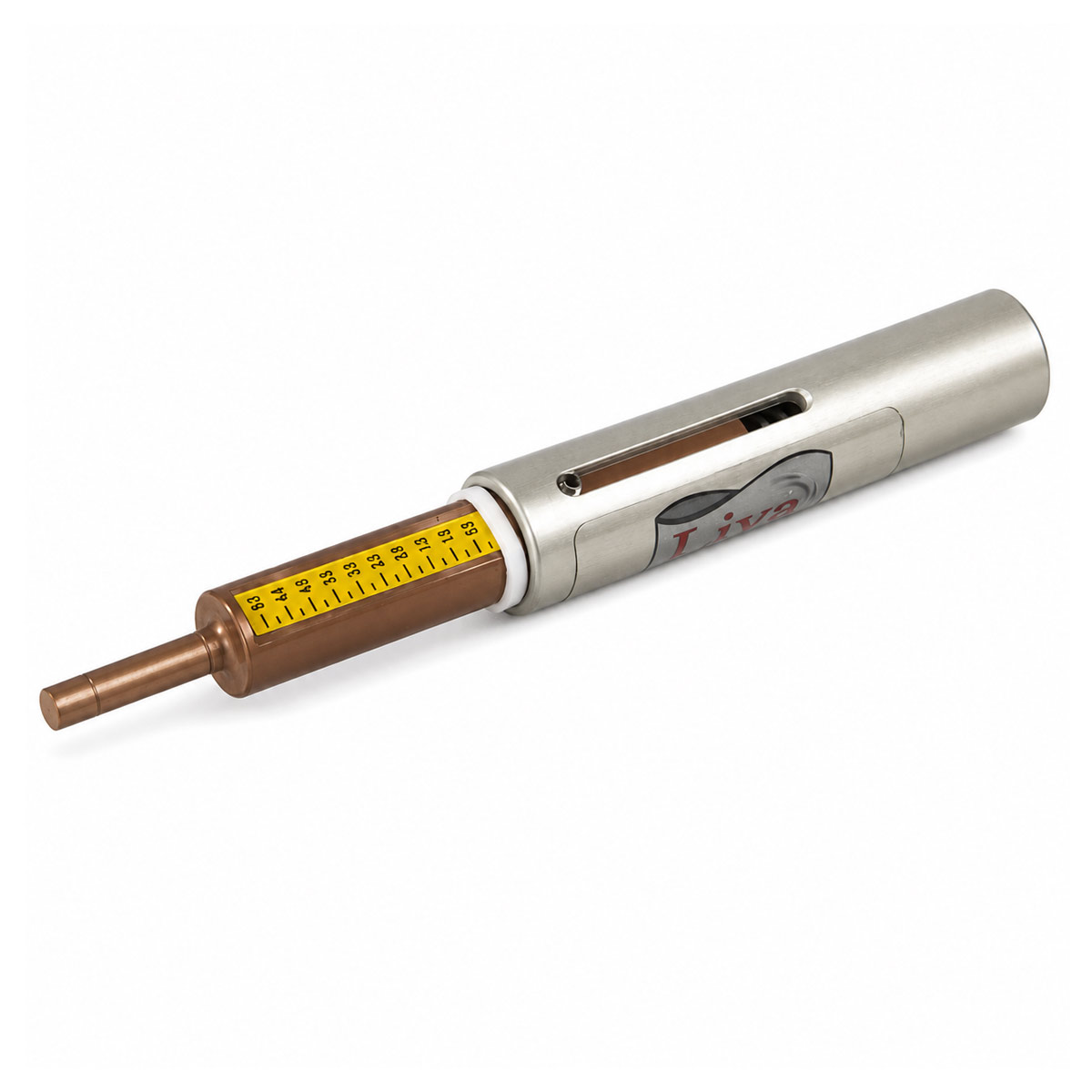
The Pocket Penetrometer is a compact and portable instrument designed for rapid evaluation of the consistency and approximate unconfined compressive strength of cohesive soils in the field or laboratory. The instrument uses a 6.35 mm diameter penetration piston and provides a measuring range of approximately 0–5 kgf/cm².
- Cohesive soil testing: Suitable for rapid evaluation of clay and similar fine-grained cohesive soils.
- Consistency assessment: Helps compare soft, firm and stiffer cohesive soil conditions.
- Approximate strength indication: Provides an approximate indication of unconfined compressive strength.
- Measurement range: Approximately 0–5 kgf/cm².
- Piston diameter: Standard penetration piston is Ø6.35 mm.
- Rapid field testing: Provides immediate readings without complex laboratory equipment.
- Laboratory applications: Can be used for preliminary checks on suitable soil samples.
- Manual operation: Requires no electrical, hydraulic or pneumatic power.
- Portable design: Compact dimensions allow easy transport in field investigations.
- Index testing: Intended for preliminary evaluation rather than engineering design values.
- External dimensions: 2 × 2 × 18 cm.
- Approximate weight: 0.5 kg.
- Product code: LT-S0105.
| Product Code | Product Name | Measurement Range | Piston Diameter (mm) | External Dimensions (cm) | Weight (kg) |
| LT-S0105 | Pocket Penetrometer | 0–5 kgf/cm² | 6.35 | 2 × 2 × 18 | 0.5 |

What Is a Pocket Penetrometer?
The Pocket Penetrometer is a compact handheld instrument used for rapid preliminary evaluation of cohesive soils. It provides an immediate indication of soil consistency and can be used to approximate the unconfined compressive strength of suitable fine-grained materials.
The LT-S0105 Pocket Penetrometer is designed for both field and laboratory applications. Its completely mechanical design means that no electrical power, hydraulic unit or compressed-air supply is required.
The instrument is particularly useful during geotechnical site investigations where engineers and technicians need a quick indication of changing soil conditions before detailed laboratory testing is performed.
0–5 kgf/cm² Measurement Range
The LT-S0105 provides an approximate measuring range of 0–5 kgf/cm².
The operator presses the penetration piston vertically into a prepared soil surface. Resistance from the soil acts against the internal spring mechanism and produces a reading on the instrument scale.
The reading provides a quick indication of material consistency and approximate compressive strength. However, results should be treated as comparative or preliminary values rather than final design parameters.
One important correction is required on the existing technical table: the unit should be kgf/cm², not kg/cm³. ASTM D8605/D8605M-26 itself recognizes kilograms-force per square centimetre as one of the traditional strength units used with pocket penetrometers.
6.35 mm Penetration Piston
The instrument uses a standard Ø6.35 mm penetration piston.
During testing, the piston is pressed into the cohesive soil surface to the specified penetration position. Soil resistance against the piston produces the instrument reading.
For more reliable comparative results, the test should be performed on a flat and representative surface. Air-dried surfaces, coarse particles or disturbed areas can significantly influence the reading.
ASTM notes that pocket penetrometer readings generally correlate best with saturated silty clays and clays without significant particles larger than 2 mm.
Cohesive Soil Consistency Evaluation
The Pocket Penetrometer is mainly intended for cohesive soils such as clays and clay-rich fine-grained materials.
It can help users compare differences in consistency between several locations or samples. Therefore, it is useful during preliminary soil classification, sample inspection and planning of further laboratory testing.
The instrument is not suitable for dry, crumbly, fissured or noncohesive soils such as sands and gravels. ASTM also warns that coarse particles and heterogeneous soil structures can adversely affect measurements.
ASTM D8605/D8605M-26
The current standard directly associated with this type of equipment is ASTM D8605/D8605M-26 — Standard Test Method for Use of the Pocket Penetrometer on Cohesive Soils.
ASTM published the current edition in 2026. The method covers the use of pocket penetrometers in both field and laboratory conditions and identifies the instrument as a simple portable method for evaluating cohesive-soil consistency.
The standard also makes an important distinction: the Pocket Penetrometer is an index testing device, not a complete engineering strength test. Its readings may help approximate unconfined compressive strength, but they must not replace controlled laboratory testing when design values are required.
Relationship with ASTM D2166/D2166M-24
When accurate unconfined compressive strength is required, ASTM D2166/D2166M-24 provides the laboratory test method for determining the unconfined compressive strength of cohesive soil under controlled axial loading.
Therefore, LT-S0105 can be used for rapid preliminary assessment, while a dedicated compression test should be selected when verified strength values are required for engineering evaluation.
Compact Field Testing Instrument
The LT-S0105 measures approximately 2 × 2 × 18 cm and weighs about 0.5 kg. Its compact dimensions allow the instrument to be carried easily during field investigations and used at multiple sampling points.
Overall, the Pocket Penetrometer provides a simple, fast and portable solution for preliminary evaluation of cohesive soil consistency and approximate compressive strength.