
Le Chatelier Test Set
STANDART: TS EN 196-3, 450-1, 459-2; TS EN ISO 9597
LT-CE0062 Le Chatelier Mould
LT-CE0063 Le Chatelier Test Set
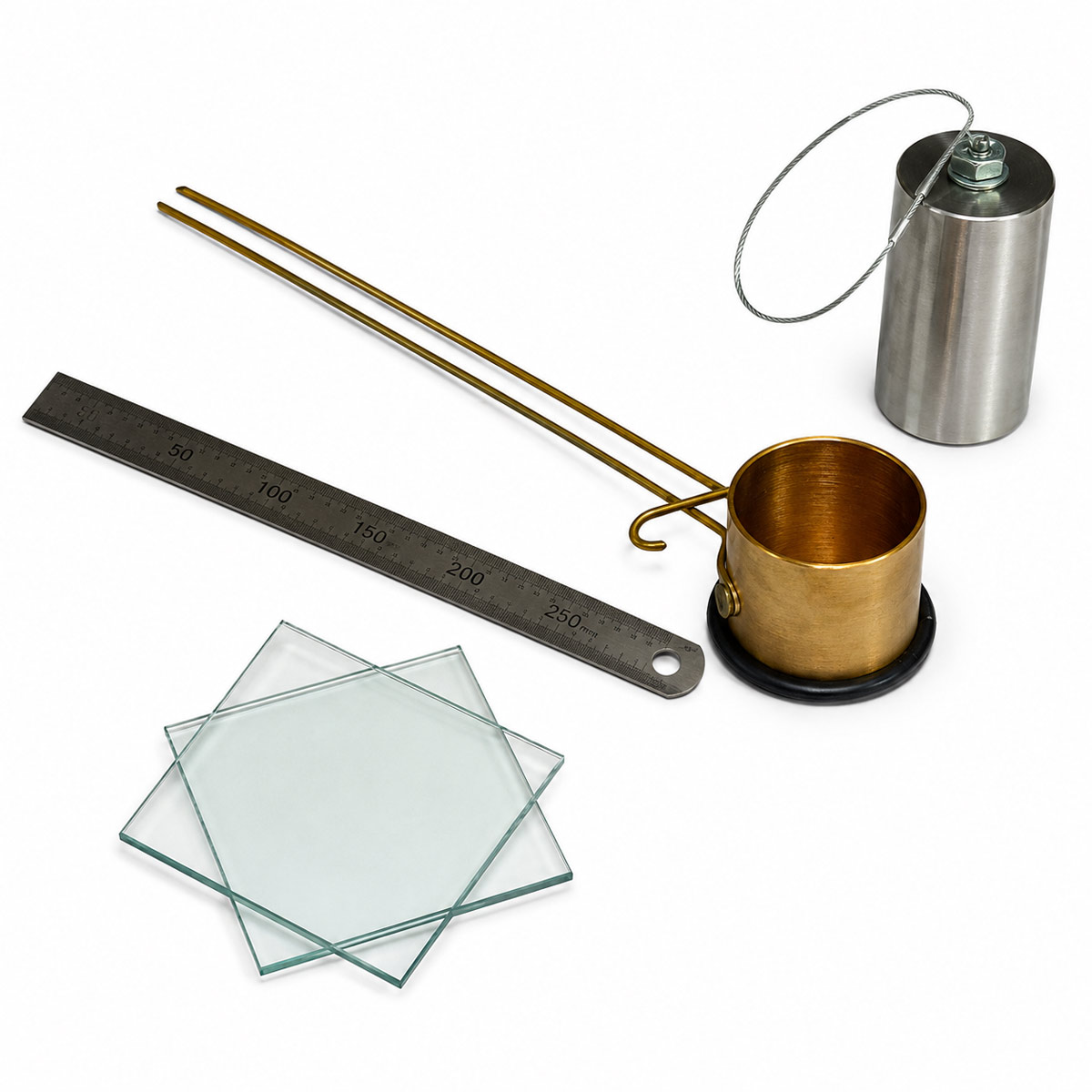
Le Chatelier Test Set is designed to determine the soundness and expansion of cement, fly ash and suitable lime samples. The split cylindrical mould transfers specimen expansion to its indicator arms, allowing dimensional changes to be measured after the prescribed conditioning and heating procedure. The complete set includes Le Chatelier moulds, glass plates, weights, tamping rod, steel ruler and carrying case.
- Cement Soundness Testing: Evaluates excessive expansion of hardened cement paste.
- Split Cylindrical Mould: Expansion of the specimen causes movement of the indicator arms.
- 30 mm Internal Diameter: Standard mould geometry for controlled specimen preparation.
- 30 mm Mould Height: Provides the required cylindrical test volume.
- 150 mm Indicator Arms: Allow small mould expansion to be measured easily.
- 50 × 50 mm Glass Plates: Hold the specimen securely during preparation and conditioning.
- Complete Test Set: Supplied with 3 Le Chatelier moulds.
- Weights Included: Includes 1 × 300 g and 3 × 100 g weights.
- Tamping Rod: Ø17 mm, approximately 70 g.
- Steel Ruler: Used to determine movement between the indicator tips.
- Carrying Case: Protects and stores the complete accessory set.
- Product Codes: LT-CE0062 mould and LT-CE0063 complete test set.
| Product Code | Product Name | Dimensions (mm) | Weight (kg) |
| LT-CE0063 | Le Chatelier Test Set | 340 × 290 × 80 | 2 |

Le Chatelier Test Set for Cement Soundness Testing
The Le Chatelier Test Set determines the soundness of cement by measuring expansion under specified test conditions. Excessive expansion after setting can indicate undesirable volume instability. Therefore, soundness testing is an important part of cement quality control.
The system uses a split cylindrical metal mould fitted with two long indicator arms. When the cement paste expands, the mould opens slightly and the indicator tips move apart. The operator measures this movement to evaluate the specimen.
Split Le Chatelier Mould
The Le Chatelier Mould has an internal diameter of approximately 30 mm, a height of 30 mm and indicator arms approximately 150 mm long. The split construction allows very small dimensional changes in the specimen to produce measurable movement at the indicator tips.
Before testing, the operator fills the mould with prepared cement paste. Glass plates are positioned above and below the mould to maintain specimen shape during conditioning.
Soundness Measurement
After the initial conditioning period, the distance between the indicator tips is recorded. The specimen is then treated according to the selected test procedure, including controlled heating in a suitable water bath.
As expansion occurs, the mould opens and the indicator arms move. The operator measures the final distance and compares it with the initial reading.
This simple mechanical principle requires no electronic sensor and provides a direct method for checking cement volume stability.
Complete Accessory Set
The LT-CE0063 Le Chatelier Test Set is supplied with three moulds, six 50 × 50 mm glass plates, one 300 g weight, three 100 g weights, a Ø17 mm tamping rod, steel ruler and plastic carrying case.
The complete arrangement allows laboratories to prepare, condition and measure several specimens with the required accessories available in one package.
EN 196-3 Soundness Testing
EN 196-3:2016 defines methods for determining cement setting times and soundness and identifies the Le Chatelier apparatus as the reference equipment for soundness testing.
ISO 9597:2008 provides corresponding international methods for cement consistency, setting time and soundness.
As a result, the Le Chatelier Test Set combines a precise split mould, measurement accessories and a simple mechanical test principle for reliable cement soundness evaluation.