
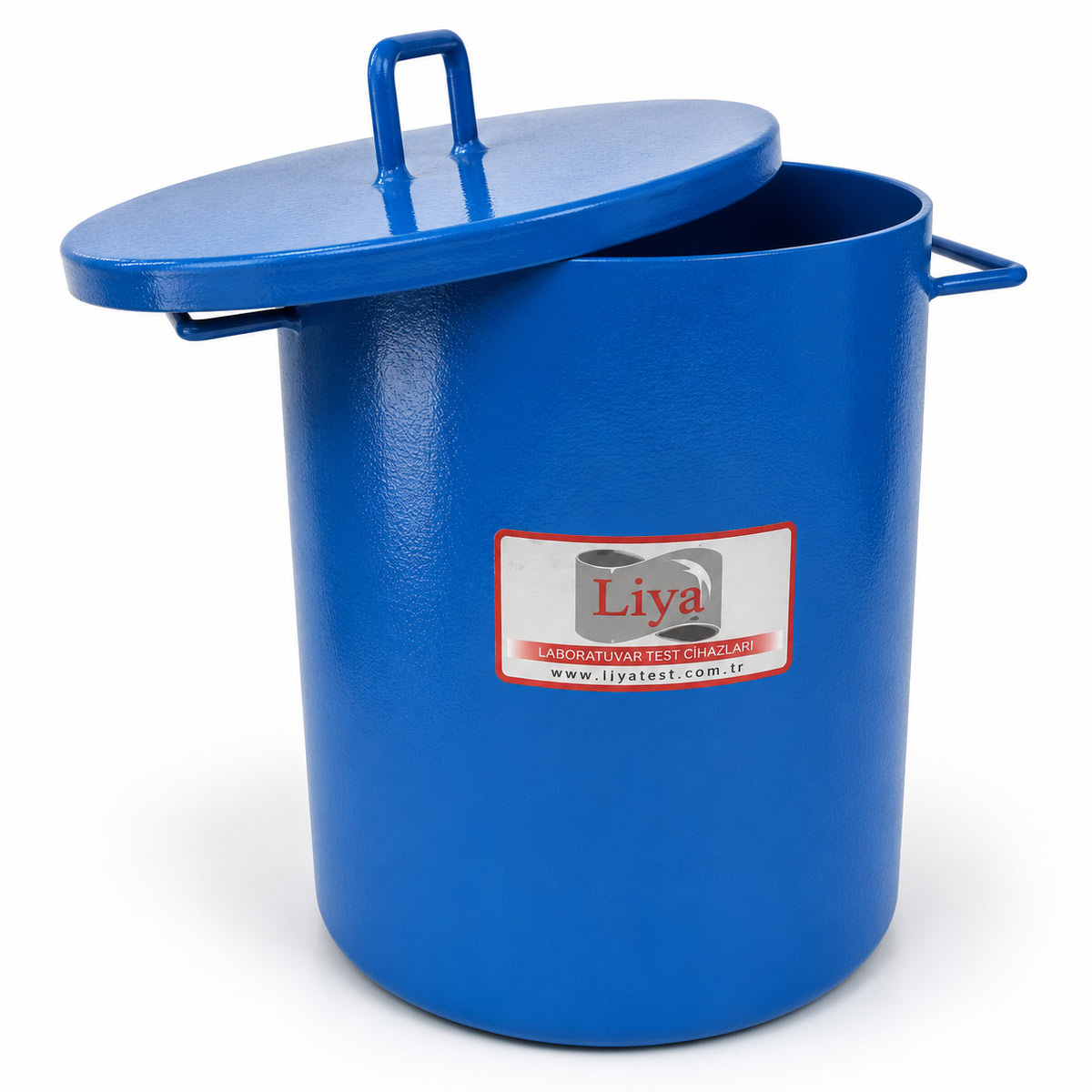
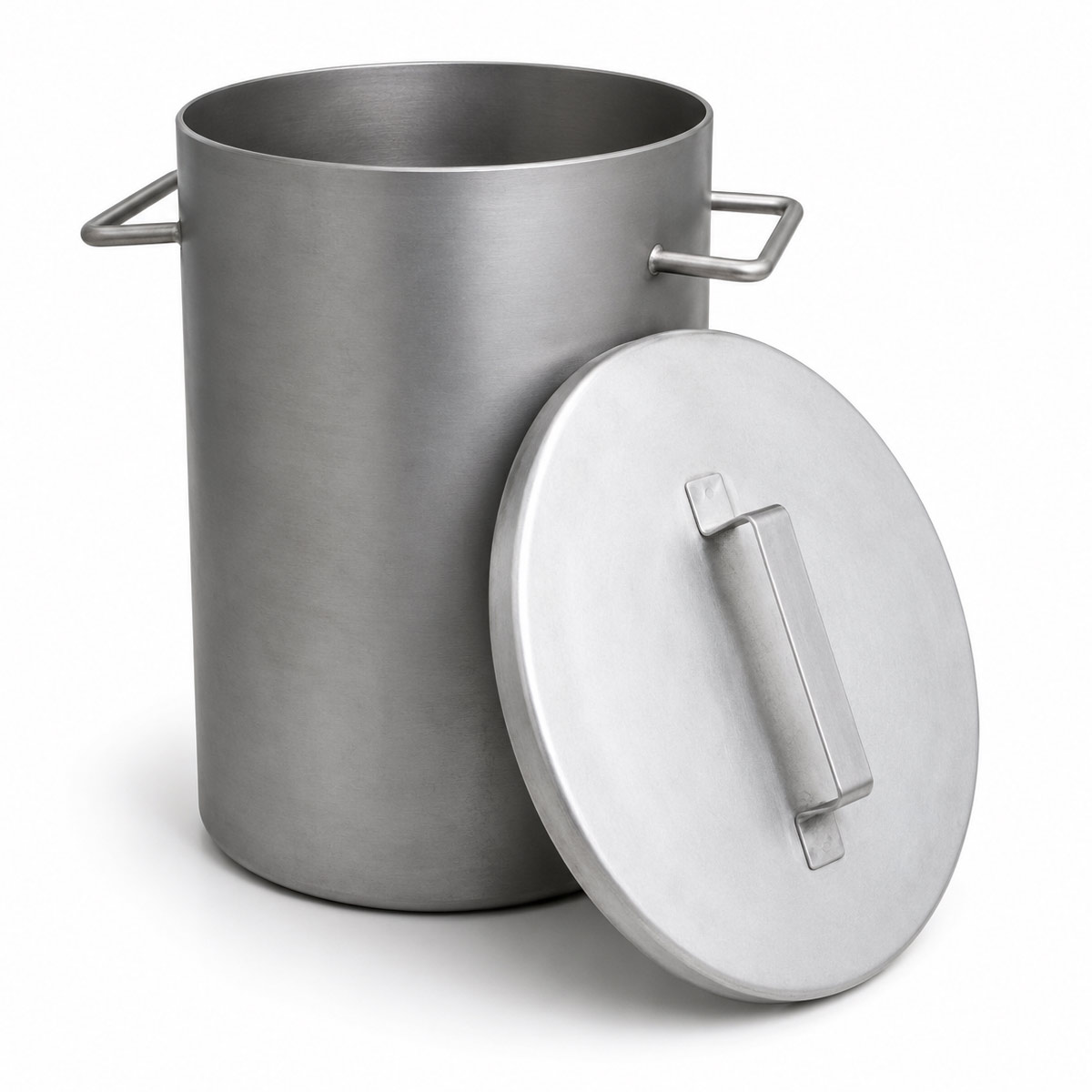
Fresh Concrete Bleeding Test Apparatus determines the amount of mixing water that rises to the surface of fresh concrete during the bleeding process. The stainless-steel container keeps the concrete specimen stable throughout the test, while the operator collects the surface water at specified intervals. The measured water quantity allows laboratories to evaluate both the total bleeding amount and the bleeding behaviour of different concrete mixtures.
- Fresh concrete analysis: Measures the amount of bleed water accumulating on the concrete surface.
- Approximate capacity: 14 liters
- Internal dimensions: Approximately Ø255 × 280 mm
- Construction: Durable stainless steel
- Cylindrical design: Helps maintain consistent specimen geometry during testing.
- Smooth internal surface: Simplifies filling, sampling and cleaning.
- Mix comparison: Supports comparison of bleeding behaviour between different concrete mixtures.
- Admixture evaluation: Helps assess the influence of chemical admixtures on concrete bleeding.
- Quality control: Provides useful information about fresh concrete stability and surface behaviour.
- Standards: ASTM C232/C232M and EN 480-4
| Product Code | Product Name | Capacity (L) | Internal Dimensions (mm) | Overall Dimensions (cm) | Weight (kg) |
| LT-C0065 | Fresh Concrete Bleeding Test Apparatus | ≈14 | Ø255 × 280 | 29 × 25 × 35 | 6 |

LT_BETON_TAZEBETONDATERLEME_
What Is a Fresh Concrete Bleeding Test Apparatus?
The Fresh Concrete Bleeding Test determines the amount of mixing water that rises to the surface of a fresh concrete specimen. Bleeding occurs as solid particles settle within the concrete mixture and part of the mixing water moves upward.
During the test, the laboratory collects the water accumulating on the concrete surface at specified intervals. The operator records each quantity and calculates the total amount of bleed water. As a result, different concrete mixtures can be compared using numerical test data.
Why Is Bleeding Testing Important?
Excessive bleeding may cause water to accumulate on the concrete surface. In addition, it can influence surface stability and subsequent finishing operations.
For this reason, concrete producers can compare different mix designs according to their bleeding behaviour. The test can also provide useful information when evaluating changes in the water-cement ratio, aggregate grading or chemical admixture dosage.
However, bleeding results alone do not define the overall durability or performance of concrete. Therefore, laboratories should assess the results together with other fresh and hardened concrete tests.
Stainless-Steel Test Container
The apparatus consists of a cylindrical container with an approximate capacity of 14 liters. Its internal dimensions are approximately Ø255 mm in diameter and 280 mm in height.
The stainless-steel construction provides a durable surface for repeated contact with fresh concrete and water. In addition, the smooth internal surface simplifies specimen placement and cleaning after the test.
The rigid cylindrical body also helps maintain consistent specimen geometry throughout the testing procedure.
How Is the Bleeding Test Performed?
First, the operator places the fresh concrete specimen into the container. The sample is then compacted according to the applicable test method. After preparation, the container remains on a stable and vibration-free surface.
As bleed water begins to collect on the surface, the operator carefully removes it at the specified time intervals. Each collected amount is recorded throughout the test.
At the end of the procedure, the laboratory calculates the total amount of bleed water. The result may also be expressed relative to the quantity of mixing water contained in the concrete.
This approach allows laboratories to compare different mixtures under similar test conditions.
Testing According to ASTM C232/C232M
ASTM C232/C232M specifies methods for determining the bleeding of freshly mixed concrete. The procedure evaluates both the amount of water that rises to the surface and the rate at which bleeding occurs.
The test provides useful data for comparing concrete mixtures and monitoring changes in fresh-concrete behaviour.
Use According to EN 480-4
EN 480-4 describes a method for determining the relative quantity of mixing water that separates from a fresh concrete specimen and rises to the surface.
The method is particularly useful when evaluating how concrete admixtures influence bleeding behaviour. Therefore, laboratories can use the results during mixture development and comparative testing.
Reliable Evaluation of Concrete Bleeding
The Fresh Concrete Bleeding Test Apparatus combines a durable stainless-steel container, standardized dimensions and straightforward operation in one practical test system.
As a result, laboratories can evaluate the bleeding tendency of fresh concrete mixtures in a consistent and comparable manner. The apparatus also supports quality-control and mix-development studies according to ASTM C232/C232M and EN 480-4.