
Length Gauge | Elongation Index BS
STANDART: BS 812
LT-A0045 Length Gauge | Elongation Index BS
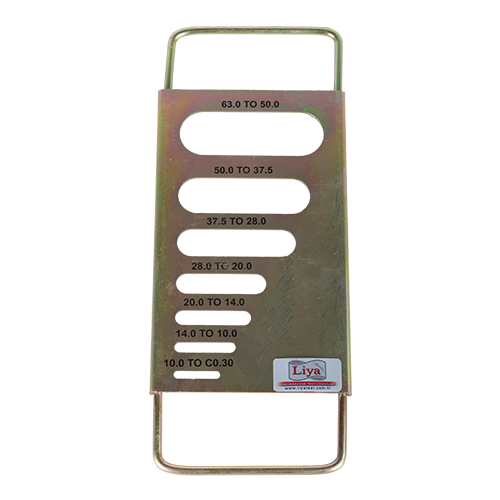
Length Gauge (Elongation Index BS) is a mechanical apparatus used to identify elongated particles in coarse aggregate and determine the Elongation Index. The test is applicable to aggregate fractions between 6.3 mm and 50 mm. A particle is classified as elongated when its greatest dimension is more than 1.8 times the mean sieve size of the corresponding fraction. The compact mechanical design provides a simple and practical solution for aggregate particle shape analysis.
- Elongated Particle Determination: Identifies unusually long particles in coarse aggregate samples.
- Elongation Index Analysis: Supports calculation of the mass percentage of elongated particles.
- 1.8 Length Criterion: A particle is elongated when its greatest dimension exceeds 1.8 times the mean sieve size.
- Aggregate Size Range: Suitable for coarse aggregate fractions between 6.3 mm and 50 mm.
- Six Aggregate Fractions: Each particle size group is evaluated separately.
- Mechanical Operation: Requires no electrical power or special installation.
- Compact Design: Suitable for routine laboratory testing and easy storage.
- Product Code: LT-A0045.
- Standard Method: BS 812-105.2 for determination of the elongation index of coarse aggregate.
| Product Code | Product Name | Dimensions (mm) | Weight (kg) |
| LT-A0045 | Length Gauge (Elongation Index BS) | — | — |
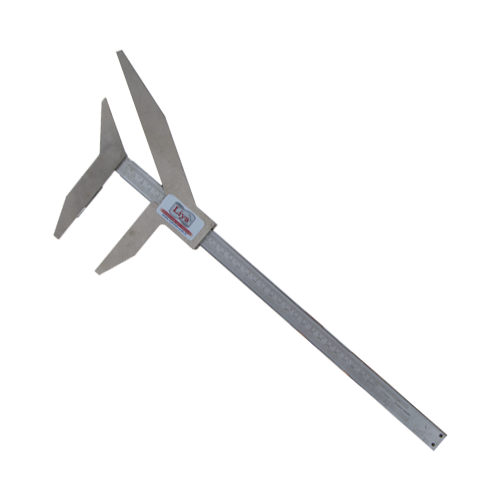
| LT-A0046 | Shape Index Caliper | 470 × 170 × 50 | 0.5 |

LT_UZUNLUKINDEX_
What Is a Length Gauge?
The Length Gauge is a mechanical aggregate testing apparatus used to determine the Elongation Index of coarse aggregate particles. It evaluates the greatest dimension of individual particles and helps laboratories identify aggregate particles that are excessively elongated.
Particle shape is an important characteristic in aggregate quality control. Long and narrow particles may behave differently during handling, compaction and placement. Therefore, determining the proportion of elongated particles helps laboratories compare aggregate sources using a consistent test procedure.
BS 812-105.2:1990 defines the traditional British method for determining the elongation index of coarse aggregate.
6.3–50 mm Aggregate Size Range
The test applies to aggregate particles between 6.3 mm and 50 mm.
Before measurement, the sample is separated into the required size fractions using standard test sieves. Each fraction is weighed and evaluated separately using the corresponding section of the Length Gauge.
Material passing the 6.3 mm sieve and material retained on the 50 mm sieve are outside the scope of this particular method.
1.8 Elongation Criterion
The BS method classifies an aggregate particle as elongated when its greatest dimension is greater than 1.8 times its mean sieve size.
The mean sieve size is calculated from the average of the limiting sieve apertures defining the particle-size fraction.
For example, particles belonging to different sieve fractions are not checked against one universal length. Each fraction has its own corresponding dimensional limit. This approach allows particles of different sizes to be evaluated using the same proportional criterion.
How Is the Elongation Index Test Performed?
First, the coarse aggregate sample is dried and separated into the specified sieve fractions. Each applicable fraction is then weighed.
The operator checks each particle using the corresponding opening of the Length Gauge. Particles whose greatest dimension exceeds the specified gauge limit are classified as elongated and collected separately.
After all applicable particles have been evaluated, the elongated particles are weighed.
Their total mass is then expressed as a percentage of the mass of the aggregate sample tested. This value is reported as the Elongation Index.
Mechanical and Practical Design
The LT-A0045 Length Gauge works entirely through mechanical comparison. No electrical connection, digital sensor or software is required.
This makes the apparatus suitable for routine testing in aggregate laboratories, quarries and quality-control facilities. Its straightforward design also allows rapid testing once the aggregate sample has been correctly separated into size fractions.
BS 812-105.2 Elongation Index Method
BS 812-105.2:1990 describes the determination of the elongation index of coarse aggregate. However, BSI currently classifies this standard as withdrawn, with a withdrawal date of 19 June 2014.
The LT-A0045 Length Gauge (Elongation Index BS) nevertheless provides the mechanical geometry required when this historical BS method is specified in an existing project, laboratory procedure or specification.