
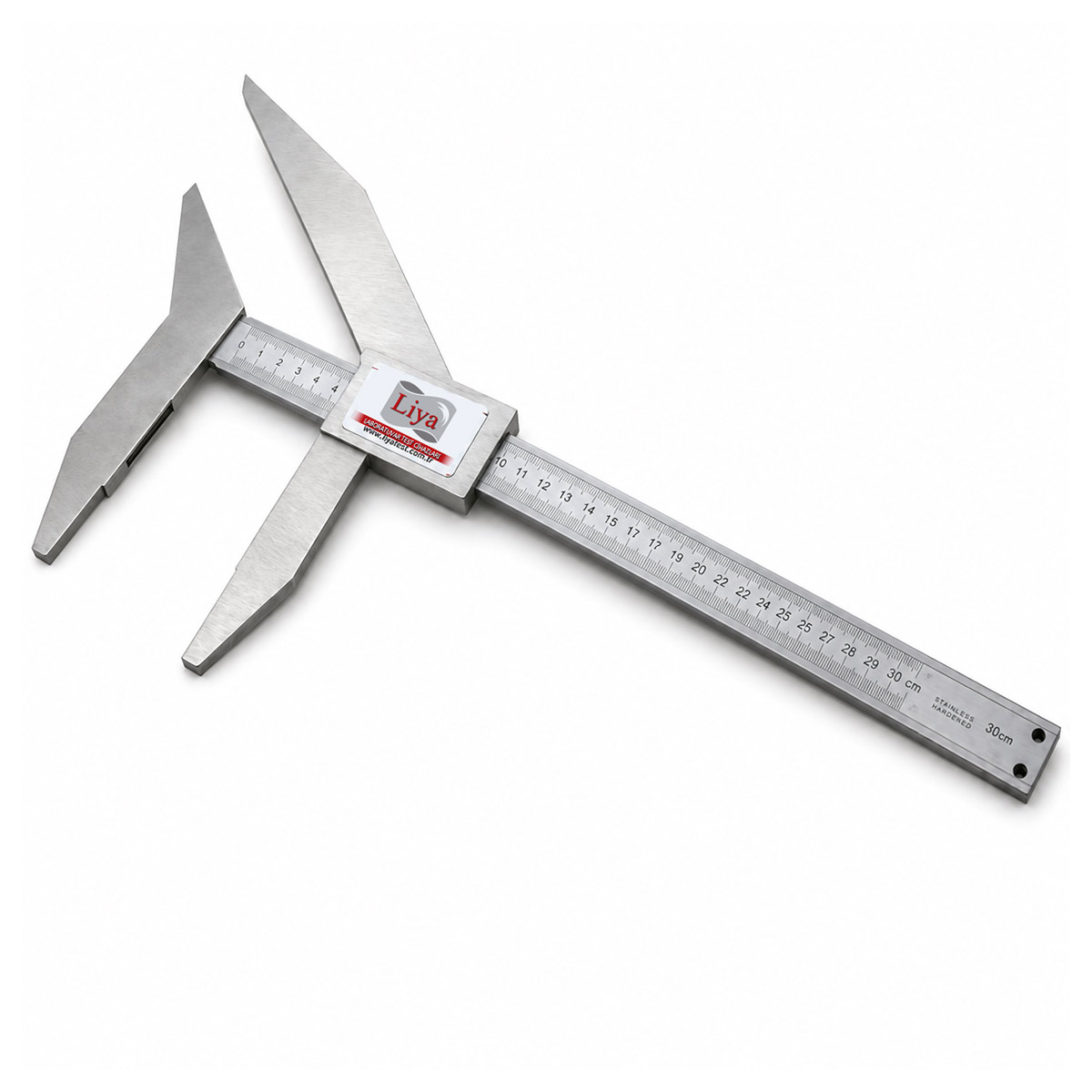
Shape Index Caliper
STANDART: EN 933-4; DIN 4226; CNR No.95; NLT 354
LT-A0046 Shape Index Caliper
Shape Index Caliper is a precision mechanical measuring instrument used to determine the shape index of coarse aggregate particles. The caliper allows the length and thickness of individual particles to be compared in accordance with the applicable test method. With a 200 mm measuring range, 0.05 mm graduations and lightweight construction, it provides a practical solution for routine aggregate shape analysis.
- Aggregate Shape Analysis: Evaluates the geometrical characteristics of coarse aggregate particles.
- Shape Index Determination: Supports classification of particles according to their length-to-thickness relationship.
- 200 mm Measuring Range: Suitable for a wide range of coarse aggregate particle sizes.
- 0.05 mm Graduations: Provides precise mechanical readings.
- Vernier-Type Measurement: Allows particle dimensions to be read directly and accurately.
- Mechanical Operation: Requires no electrical power or software.
- Compact Design: External dimensions are 470 × 170 × 50 mm.
- Lightweight Construction: Approximate weight is only 0.5 kg.
- Product Code: LT-A0046.
- Standards: EN 933-4, DIN 4226, CNR No.95 and NLT 354.
| Product Code | Product Name | Dimensions (mm) | Weight (kg) |
| LT-A0046 | Shape Index Caliper | 470 × 170 × 50 | 0.5 |

LT_SEKILINDEX_
What Is a Shape Index Caliper?
The Shape Index Caliper is a precision mechanical instrument used to determine the shape characteristics of coarse aggregate particles. It measures the greatest length and smallest thickness of individual particles so that their geometrical proportions can be evaluated.
Particle shape is an important parameter in aggregate quality control. Irregular, excessively elongated or non-cubical particles may influence packing, compaction and the behaviour of aggregate mixtures. For this reason, shape index testing provides useful quantitative information when comparing different aggregate sources.
The LT-A0046 Shape Index Caliper has a 200 mm measuring range with graduations at 0.05 mm intervals, allowing individual aggregate particles to be measured accurately. Similar equipment used for EN 933-4 testing follows the same measurement principle.
200 mm Precision Measuring Range
The caliper provides a maximum measurement capacity of 200 mm. This range allows the operator to evaluate a broad selection of coarse aggregate particle sizes with a single instrument.
Its graduated scale is divided into 0.05 mm increments. The operator places the aggregate particle between the measuring surfaces and records its dimensions directly from the scale.
Because the device works mechanically, no electronic calibration, electrical connection or software is required.
How Is the Shape Index Determined?
EN 933-4 determines the shape index by evaluating individual coarse aggregate particles.
For each particle, the greatest dimension L and the smallest dimension E are considered. A particle is classified as non-cubical when the ratio L/E is greater than 3.
After the relevant particles have been classified, their mass is compared with the total mass of the test portion. The resulting percentage represents the Shape Index.
The current BS EN 933-4:2008 method applies to aggregate size fractions where the upper particle size is no greater than 63 mm and the lower size is at least 4 mm.
Practical Aggregate Laboratory Use
The compact design makes the instrument suitable for aggregate laboratories, quarries, concrete producers and quality-control departments.
The 470 × 170 × 50 mm body and approximate 0.5 kg weight make it easy to carry between work areas. Since measurements are performed directly on individual particles, sample evaluation can begin immediately after the aggregate has been prepared and separated into the required fractions.
EN 933-4 Shape Index Testing
EN 933-4:2008 specifies the reference method for determining the shape index of coarse aggregates. BSI currently lists BS EN 933-4:2008 as the current release of the standard.
The Shape Index Caliper therefore provides a simple, accurate and repeatable solution for evaluating coarse aggregate particle geometry according to established laboratory procedures.