
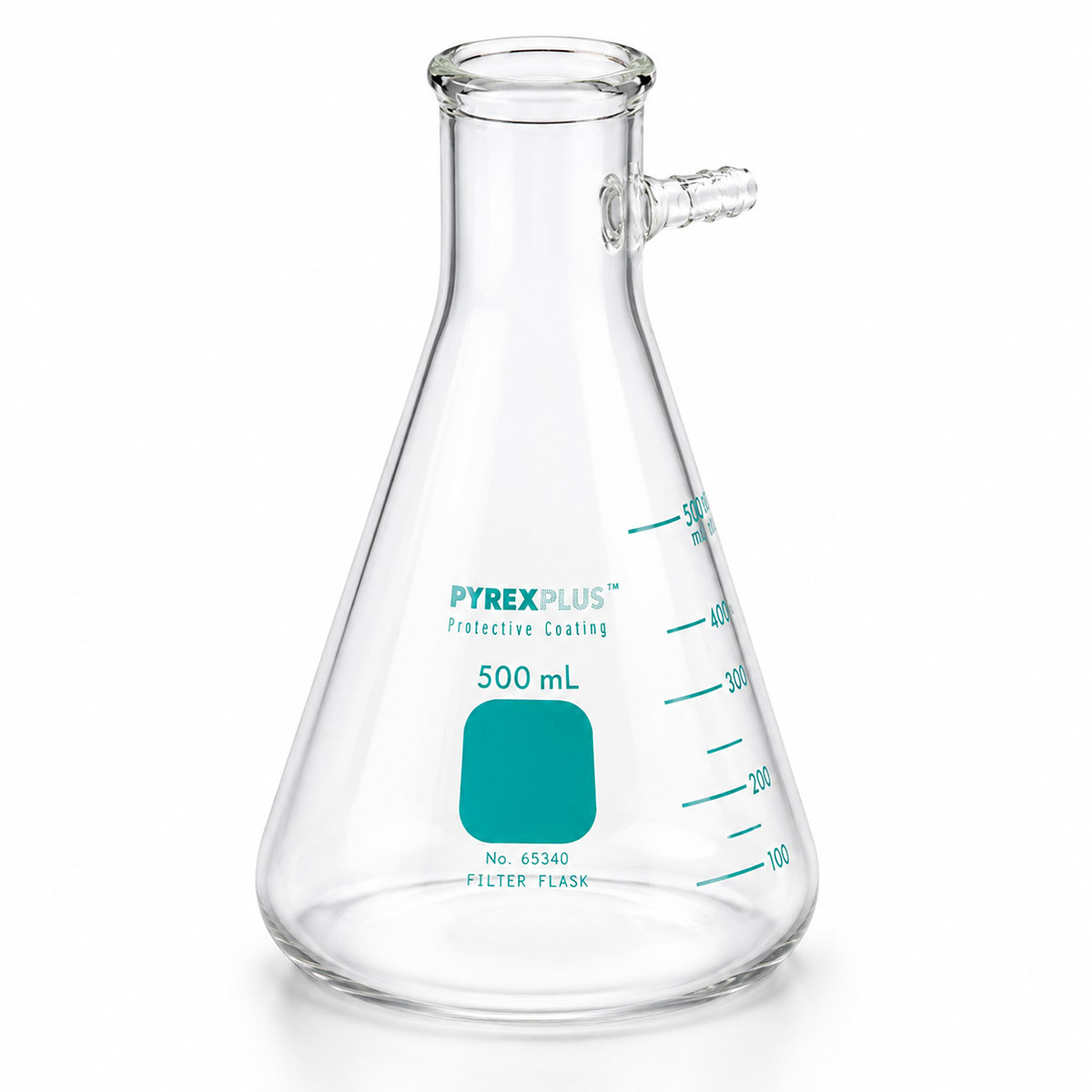
Filter Flask
STANDART: –
LT-G0092 Carsten-Röhrchen Flask
LT-G0093 Filtering Flask | 250ml
LT-G0094 Filtering Flask | 500ml
LT-G0095 Filtering Flask | 1000ml
LT-G0096 Filtering Flask | 2000ml
The Filtering Flask is a laboratory glassware item designed to support vacuum filtration and liquid-solid separation procedures. Liya Test offers four different capacities from 250 mL to 2000 mL, allowing users to select a suitable flask according to sample volume. When used with an appropriate filter funnel and vacuum source, the flask collects the filtrate during laboratory filtration operations.
- LT-G0093: Filtering Flask, 250 mL
- LT-G0094: Filtering Flask, 500 mL
- LT-G0095: Filtering Flask, 1000 mL
- LT-G0096: Filtering Flask, 2000 mL
- LT-G0092: Carsten-Röhrchen Flask
- Capacity range: 250–2000 mL
- Main application: Vacuum filtration
- Liquid-solid separation: Supports laboratory filtration procedures
- Filtrate collection: Collects liquid passing through the filter medium
- Vacuum connection: Used together with a suitable vacuum source
- Filter funnel compatibility: Can be combined with an appropriate Büchner or similar filter funnel
- Laboratory use: Suitable for routine filtration and sample preparation work
- Model range: 4 different Filtering Flask capacities
| Product Code | Product Name | Capacity (mL) | Dimensions (mm) | Weight (kg) |
| LT-G0093 | Filtering Flask | 250 | 187 × 187 × 310 | 0.2 |
| LT-G0094 | Filtering Flask | 500 | 166 × 166 × 260 | 0.25 |
| LT-G0095 | Filtering Flask | 1000 | 207 × 207 × 315 | 1 |
| LT-G0096 | Filtering Flask | 2000 | 207 × 207 × 315 | 2 |
| LT-G0092 | Carsten-Röhrchen Flask | — | 100 × 100 × 200 | 0.25 |

What Is a Filtering Flask?
A Filtering Flask is a laboratory glass vessel designed for vacuum-assisted filtration and liquid-solid separation procedures.
It is commonly used together with an appropriate filter funnel, filter medium and vacuum source. During filtration, the liquid passes through the filter and collects inside the flask while solid particles remain on the filter medium.
Liya Test offers four different Filtering Flask capacities ranging from 250 mL to 2000 mL.
Vacuum Filtration Applications
Vacuum filtration uses a pressure difference to accelerate the movement of liquid through a filter medium.
The operator places the suitable filtration funnel on the flask and connects the vacuum line to the appropriate connection point. Once vacuum is applied, the liquid phase moves through the filter more rapidly than in a simple gravity-filtration arrangement.
The filtered liquid, or filtrate, is collected inside the Filtering Flask.
Four Different Capacity Options
The Liya Test range includes 250, 500, 1000 and 2000 mL models.
The LT-G0093 250 mL Filtering Flask provides a compact option for smaller sample quantities.
The LT-G0094 500 mL model supports medium-volume laboratory work.
For larger filtration volumes, the LT-G0095 1000 mL and LT-G0096 2000 mL models provide increased collection capacity.
This range allows the user to select a flask according to the expected filtrate volume and laboratory workflow.
Büchner Flask Working Principle
A Filtering Flask is also commonly referred to as a Büchner Flask or Vacuum Filter Flask.
The system generally consists of:
- filtering flask
- Büchner or compatible filter funnel
- filter paper or suitable filter medium
- sealing connection
- vacuum hose
- vacuum source
When vacuum is applied, the reduced pressure inside the flask helps draw the liquid through the filter.
This arrangement can make filtration faster and more controlled than gravity-only methods.
Liquid-Solid Separation
The main purpose of the Filtering Flask is to support the separation of solid material from a liquid phase.
Typical laboratory uses may include:
- sample preparation
- precipitate filtration
- slurry filtration
- washing solid samples
- collecting filtrate
- general liquid-solid separation
- laboratory preparation procedures
The exact filtration arrangement should always be selected according to the material and laboratory method.
Selecting the Correct Flask Capacity
The correct capacity depends on the amount of liquid expected during filtration.
Users should avoid selecting a flask that is too small for the expected filtrate volume. Sufficient free space should remain inside the flask during operation.
For lower-volume work, 250 or 500 mL models may be suitable. Larger sample volumes can be handled with 1000 or 2000 mL options.
The connected funnel and vacuum system should also be compatible with the selected flask.
Vacuum Use and Glassware Selection
Vacuum applications place different mechanical stresses on laboratory glassware compared with normal atmospheric-pressure use.
For this reason, the operator should use the product only according to the manufacturer’s intended operating conditions. The glassware should also be inspected before use for visible cracks, chips or other damage.
The current product information does not specify the maximum permitted vacuum level. Therefore, no specific vacuum-pressure rating should be added unless it is confirmed by technical documentation.
Carsten-Röhrchen Flask
The product group also includes the LT-G0092 Carsten-Röhrchen Flask.
This model is listed separately from the four Filtering Flask capacities and has dimensions of 100 × 100 × 200 mm with an approximate weight of 0.25 kg.
Because the supplied product information does not provide a capacity or detailed working specification for this model, additional technical values should not be added without confirmation.
Liya Test Filtering Flask Range
The Liya Test product group consists of:
LT-G0093 – Filtering Flask, 250 mL
LT-G0094 – Filtering Flask, 500 mL
LT-G0095 – Filtering Flask, 1000 mL
LT-G0096 – Filtering Flask, 2000 mL
LT-G0092 – Carsten-Röhrchen Flask
Overall, the Filtering Flask provides a practical laboratory solution for vacuum filtration and liquid-solid separation. With capacities from 250 to 2000 mL, the Liya Test range supports different sample volumes and routine laboratory filtration requirements.