
Pycnometer | Gay Lussac Type
STANDART: –
LT-G0063 Gay Lussac Pycnometer | 25ml
LT-G0064 Gay Lussac Pycnometer | 50ml
LT-G0065 Gay Lussac Pycnometer | 100ml
LT-G0066 Gay Lussac Pycnometer | 250ml
LT-G0067 Gay Lussac Pycnometer | 500ml
LT-G0068 Gay Lussac Pycnometer | 1000ml
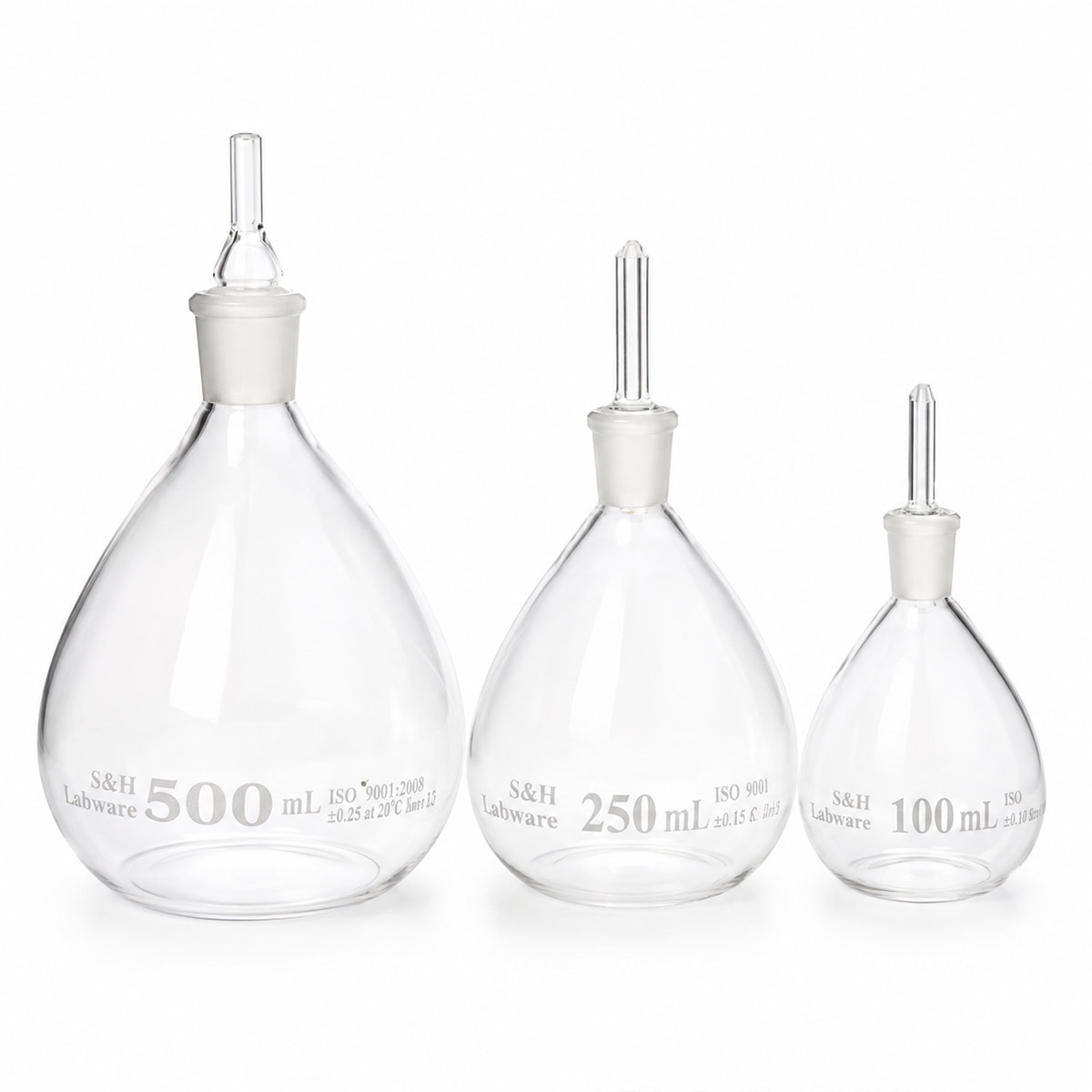
The Gay-Lussac Pycnometer is a laboratory glassware item used for the determination of liquid density by relating the mass of a liquid to a known volume. Liya Test offers six different capacities from 25 mL to 1000 mL, allowing users to select a suitable model according to sample volume and laboratory requirements.
- LT-G0063: Gay-Lussac Pycnometer, 25 mL
- LT-G0064: Gay-Lussac Pycnometer, 50 mL
- LT-G0065: Gay-Lussac Pycnometer, 100 mL
- LT-G0066: Gay-Lussac Pycnometer, 250 mL
- LT-G0067: Gay-Lussac Pycnometer, 500 mL
- LT-G0068: Gay-Lussac Pycnometer, 1000 mL
- Capacity range: 25–1000 mL
- Main application: Determination of liquid density
- Known-volume method: Supports density calculations using measured mass and calibrated volume.
- Six capacity options: Suitable for different sample quantities.
- Laboratory use: Suitable for routine density measurement and sample analysis.
- Model selection: Capacity can be selected according to required sample volume.
| Product Code | Product Name | Capacity (mL) | Dimensions (mm) | Weight (kg) |
| LT-G0063 | Gay-Lussac Pycnometer | 25 | 40 × 40 × 90 | 0.05 |
| LT-G0064 | Gay-Lussac Pycnometer | 50 | 50 × 50 × 100 | 0.05 |
| LT-G0065 | Gay-Lussac Pycnometer | 100 | 60 × 60 × 120 | 0.05 |
| LT-G0066 | Gay-Lussac Pycnometer | 250 | 100 × 100 × 150 | 0.1 |
| LT-G0067 | Gay-Lussac Pycnometer | 500 | 110 × 110 × 200 | 0.1 |
| LT-G0068 | Gay-Lussac Pycnometer | 1000 | 150 × 150 × 220 | 0.2 |

What Is a Gay-Lussac Pycnometer?
A Gay-Lussac Pycnometer is a laboratory vessel used for determining the density of liquids by measuring the mass of a known volume.
The method is based on a simple principle. The operator determines the mass of the pycnometer under controlled conditions, fills it with the liquid sample and then performs the required weighing procedure. The measured mass and known internal volume can then be used to calculate liquid density.
Liya Test offers six different capacities from 25 mL to 1000 mL.
Liquid Density Measurement
Density represents the relationship between the mass and volume of a material.
In pycnometer measurements, a precisely defined volume provides the basis for calculation. The operator weighs the vessel according to the laboratory procedure and then evaluates the mass of the contained liquid.
This approach supports density determination in routine laboratory analysis and quality-control applications.
25 to 1000 mL Capacity Options
The Liya Test range includes:
25 mL, 50 mL, 100 mL, 250 mL, 500 mL and 1000 mL capacities.
The smaller 25, 50 and 100 mL models can be selected when only a limited amount of sample is available.
The 250 and 500 mL options support medium-volume laboratory applications.
For larger sample quantities, the 1000 mL model provides the highest capacity in the product range.
Gay-Lussac Pycnometer Working Principle
The operator first prepares the clean pycnometer and performs the required weighing procedure.
The liquid sample is then added to the vessel according to the test method. After the target volume is established, the filled pycnometer is weighed again.
The difference in mass corresponds to the mass of the liquid contained in the known volume.
This allows the density to be determined using the relationship between mass and volume.
Importance of Temperature
Temperature can influence liquid volume and therefore affect density measurements.
For this reason, laboratory conditions should be controlled according to the applicable test method.
When measurements from different samples or test series are compared, using consistent temperature conditions helps improve comparability.
The exact reference temperature should be selected according to the relevant analytical procedure.
Selecting the Correct Capacity
The most suitable model depends primarily on the amount of sample available and the required test procedure.
A smaller pycnometer can reduce sample consumption when material quantity is limited.
Larger capacities may be useful when greater liquid volumes are required for the laboratory workflow.
Users should also consider:
- sample availability
- required test volume
- weighing capacity
- laboratory balance resolution
- working temperature
- cleaning requirements
Model Dimensions
The smallest LT-G0063 25 mL model measures 40 × 40 × 90 mm and weighs approximately 0.05 kg.
The largest LT-G0068 1000 mL model measures 150 × 150 × 220 mm and weighs approximately 0.20 kg.
The intermediate models provide additional size and volume options between these two configurations.
Laboratory Applications
Gay-Lussac Pycnometers can support:
- liquid density determination
- sample comparison
- quality-control measurements
- laboratory preparation procedures
- material analysis
- routine analytical work
The exact measurement procedure should follow the laboratory method being applied.
Overall, the Gay-Lussac Pycnometer provides a practical solution for liquid density determination using a known-volume measurement principle. Liya Test’s six capacity options from 25 to 1000 mL allow laboratories to select a suitable model according to sample volume and testing requirements.