
Gillmore Apparatus
STANDART: ASTM C91, C141, C150, C266; AASHTO T154
LT-A0043 Gillmore Apparatus
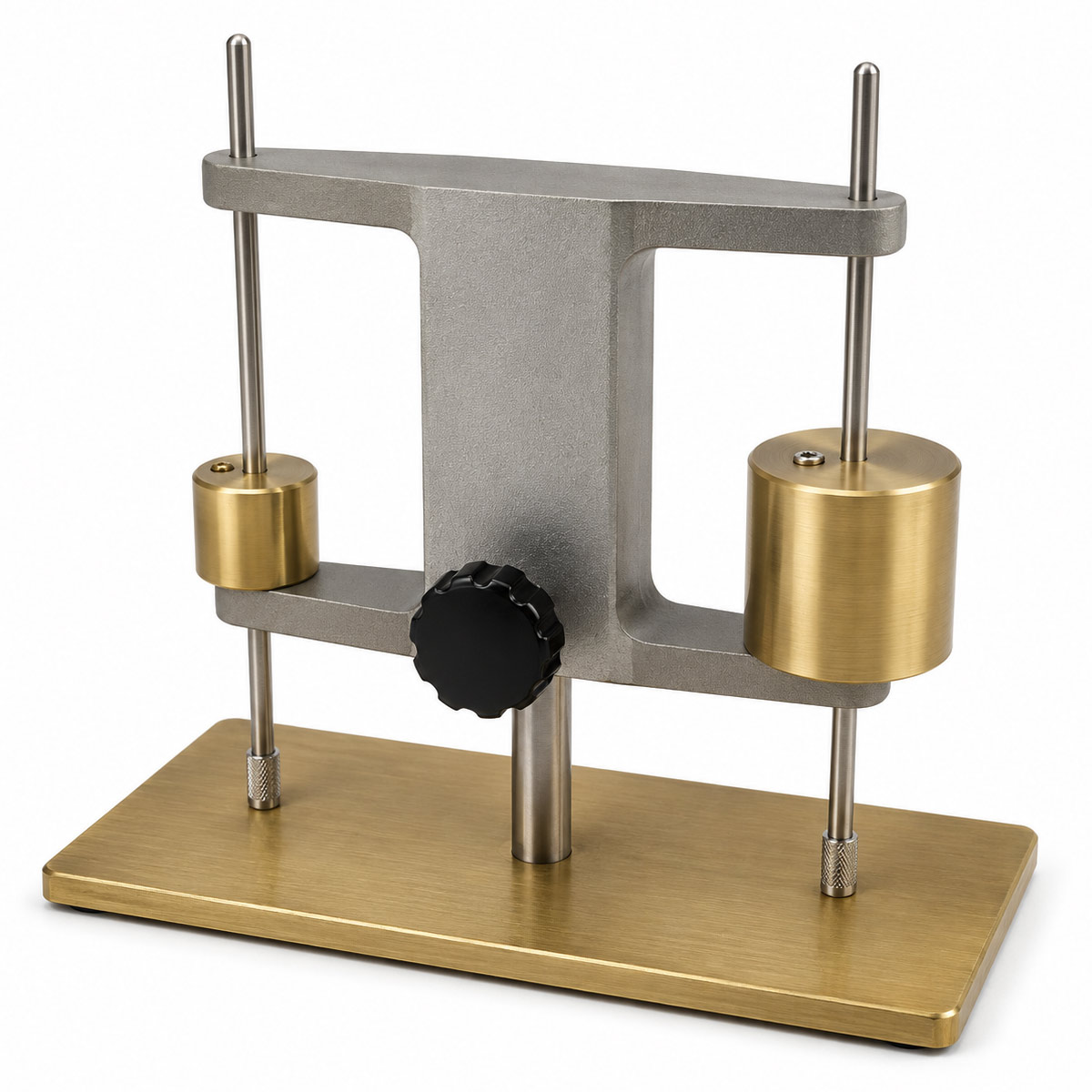
Gillmore Apparatus is designed to determine the initial and final setting times of hydraulic cement paste using two independently operated Gillmore needles. The initial-setting needle has a diameter of 2.12 mm and a total moving mass of 113.4 g, while the final-setting needle has a diameter of 1.06 mm and a total moving mass of 453.6 g. Its rigid mechanical frame and two glass plates provide a simple and repeatable system for laboratory setting-time determination.
- Initial Setting Time: Determines the beginning of cement paste setting.
- Final Setting Time: Determines the final stage of setting using a separate needle.
- Dual-Needle System: Two independent arms simplify initial and final setting checks.
- Initial Needle: Ø2.12 mm, total moving mass 113.4 g.
- Final Needle: Ø1.06 mm, total moving mass 453.6 g.
- Rigid Mechanical Frame: Maintains stable needle positioning during testing.
- Vertical Needle Movement: Helps the needles contact the specimen correctly.
- Two Glass Plates: Provide smooth surfaces for specimen preparation and testing.
- No Electrical Supply Required: Fully mechanical operation simplifies laboratory use.
- Compact Design: External dimensions are 300 × 100 × 300 mm.
- Weight: Approximately 2.5 kg.
- Product Code: LT-A0043.
- Primary Test Standard: ASTM C266-21.
| Product Code | Product Name | Dimensions (mm) | Weight (kg) | Initial Needle | Final Needle |
| LT-A0043 | Gillmore Apparatus | 300 × 100 × 300 | 2.5 | Ø2.12 mm – 113.4 g | Ø1.06 mm – 453.6 g |

LT_CIMENTO_GILLMOREAPARATI_
Gillmore Apparatus for Cement Setting Time Testing
The Gillmore Apparatus is designed to determine the initial and final setting times of hydraulic cement paste. The apparatus uses two calibrated needles with different diameters and moving masses. This arrangement allows laboratories to evaluate two distinct stages of the cement hardening process.
Setting time is an important quality-control parameter for hydraulic cement. It helps laboratories compare different cement batches and monitor changes in material behaviour during production.
Dual Gillmore Needle System
The apparatus includes two independently operated horizontal arms. One arm carries the initial-setting needle, while the second arm carries the final-setting needle.
The initial-setting needle has a diameter of 2.12 mm and a total moving mass of 113.4 g. The final-setting needle has a diameter of 1.06 mm and a total moving mass of 453.6 g.
These different geometries and loads allow the two stages of setting to be evaluated separately.
Initial Setting Time Determination
The operator first prepares the hydraulic cement paste according to the selected procedure. The specimen is then placed on the glass plate.
At defined time intervals, the initial-setting needle is carefully lowered onto the surface. As the cement paste hardens, its resistance to penetration gradually increases.
The operator continues the measurements until the specimen satisfies the initial-setting criterion specified by the applicable test method.
Final Setting Time Determination
After the initial setting point has been established, testing continues with the final-setting needle.
The heavier and smaller-diameter needle applies a different contact condition to the specimen. The operator periodically lowers the needle onto the cement paste and observes the resulting impression.
When the specimen meets the final-setting criterion, the elapsed time is recorded as the final setting time.
Rigid Mechanical Construction
The apparatus uses a rigid mechanical frame to keep both needle systems properly aligned. This structure helps the needles move vertically toward the test specimen.
Two smooth glass plates are supplied for specimen preparation and testing. Their flat surfaces provide stable support and are easy to clean after the procedure.
Because the Gillmore Apparatus operates mechanically, it does not require an electrical connection. This also simplifies routine maintenance.
ASTM C266-21 Compliance
ASTM C266-21 specifically covers determination of hydraulic-cement paste setting time by means of Gillmore needles. ASTM currently lists this edition as active.
The method is also referenced in cement specifications where Gillmore setting-time requirements apply. For example, ASTM C150/C150M-24 includes Gillmore setting time among the test methods used to evaluate Portland cement properties.
As a result, the Gillmore Apparatus combines simple mechanical operation, calibrated dual needles and a stable test frame for reliable initial and final setting-time determination.