
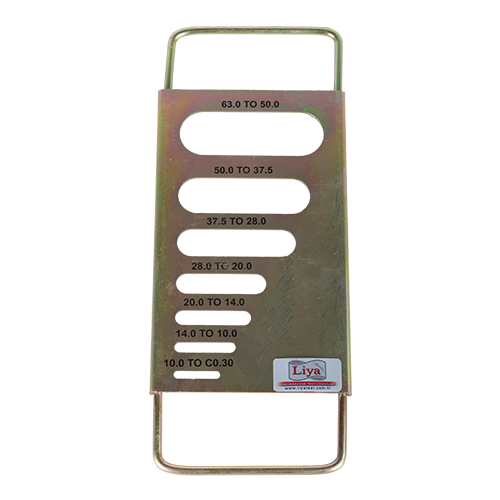
Thickness Gauge | Flakiness Index BS
STANDART: BS 812
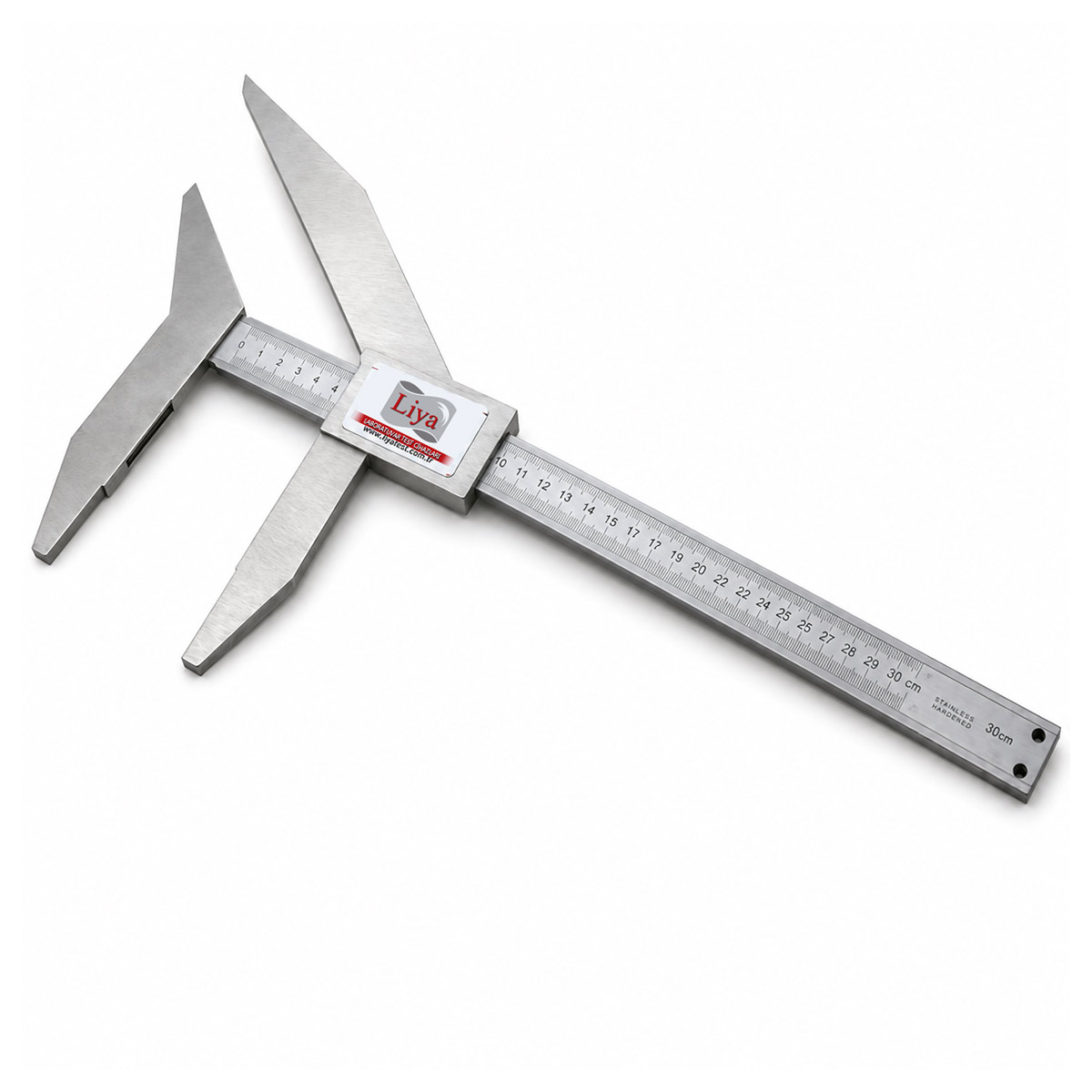
LT-A0044 Thickness Gauge | Flakiness Index BS
Thickness Gauge (Flakiness Index BS) is used to identify flaky particles in coarse aggregate samples and to determine the flakiness index. The test evaluates aggregate fractions between 6.3 mm and 63.0 mm. According to the test principle, particles with a thickness less than 0.6 times the mean sieve size of the corresponding fraction are classified as flaky. The gauge features seven precision-cut slots, providing a fast and practical mechanical method for aggregate shape analysis.
- Flaky Particle Determination: Identifies thin and flaky particles in coarse aggregate samples.
- Flakiness Index Testing: Supports calculation of the mass percentage of flaky particles.
- Aggregate Size Range: Suitable for fractions between 6.3 mm and 63.0 mm.
- 0.6 Thickness Criterion: Particles thinner than 0.6 times the mean sieve size are classified as flaky.
- Seven Precision Slots: Each aggregate fraction is checked using its corresponding opening.
- Slot Dimensions: 4.9 × 30, 7.2 × 40, 10.2 × 50, 14.4 × 60, 19.7 × 80, 26.3 × 90 and 33.9 × 100 mm.
- Mechanical Operation: Requires no electricity or special installation.
- Compact Design: Suitable for routine aggregate laboratory testing.
- Product Code: LT-A0044.
- Standard: BS 812-105.1.
| Product Code | Product Name | Dimensions (mm) | Weight (kg) |
| LT-A0044 | Thickness Gauge (Flakiness Index BS) | 310 × 130 × 10 | 0.4 |
What Is a Thickness Gauge?
The Thickness Gauge is a mechanical aggregate testing apparatus used to determine the flakiness index of coarse aggregate particles. It classifies particles according to their smallest dimension and helps laboratories evaluate aggregate particle shape using a repeatable procedure.
Aggregate shape can influence the behaviour of construction materials. Excessive quantities of flat or flaky particles may affect packing, compaction and the overall performance of aggregate mixtures. For this reason, flakiness index testing is commonly used during aggregate quality control.
BS 812-105.1 specifically describes the method for determining the flakiness index of coarse aggregates. BSI currently lists the standard as current and under review.
6.3–63 mm Aggregate Size Range
The test is performed on coarse aggregate fractions between 6.3 mm and 63.0 mm.
Before using the gauge, the aggregate sample is separated into the required sieve fractions. Each fraction is then evaluated independently using the corresponding opening on the Thickness Gauge.
This separation is important because each aggregate size group requires a different dimensional limit.
0.6 Flakiness Criterion
Under the BS method, an aggregate particle is considered flaky when its thickness is less than 0.6 times the mean sieve size of the fraction to which it belongs.
The operator attempts to pass each particle through the appropriate slot. Particles passing through the slot are separated and weighed.
The total mass of these flaky particles is then compared with the total mass of the test sample. The result is reported as the Flakiness Index, expressed as a percentage.
Seven Precision-Cut Slots
The Thickness Gauge incorporates seven openings for the different aggregate fractions:
- 4.9 × 30 mm
- 7.2 × 40 mm
- 10.2 × 50 mm
- 14.4 × 60 mm
- 19.7 × 80 mm
- 26.3 × 90 mm
- 33.9 × 100 mm
These dimensions correspond to the BS flakiness-index testing arrangement and allow each fraction to be evaluated using the same dimensional principle.
How Is the Flakiness Index Test Performed?
First, the aggregate sample is dried and separated into the specified sieve fractions. Each fraction is weighed individually.
The operator then checks the particles using the appropriate slot on the gauge. Particles that pass through the thickness opening are collected separately.
After all applicable fractions have been tested, the flaky particles are weighed. Their combined mass is compared with the original test mass to calculate the Flakiness Index percentage.
Because the apparatus is entirely mechanical, it does not require electrical power, calibration electronics or complex setup.
BS 812-105.1 Aggregate Testing
BS 812-105.1:1989 covers the determination of the flakiness index of coarse aggregates. The standard remains listed by BSI as current, although it is presently under review.
The LT-A0044 Thickness Gauge (Flakiness Index BS) combines seven defined slot sizes with a compact mechanical design. It therefore provides aggregate laboratories with a simple and repeatable method for evaluating coarse aggregate particle shape.