
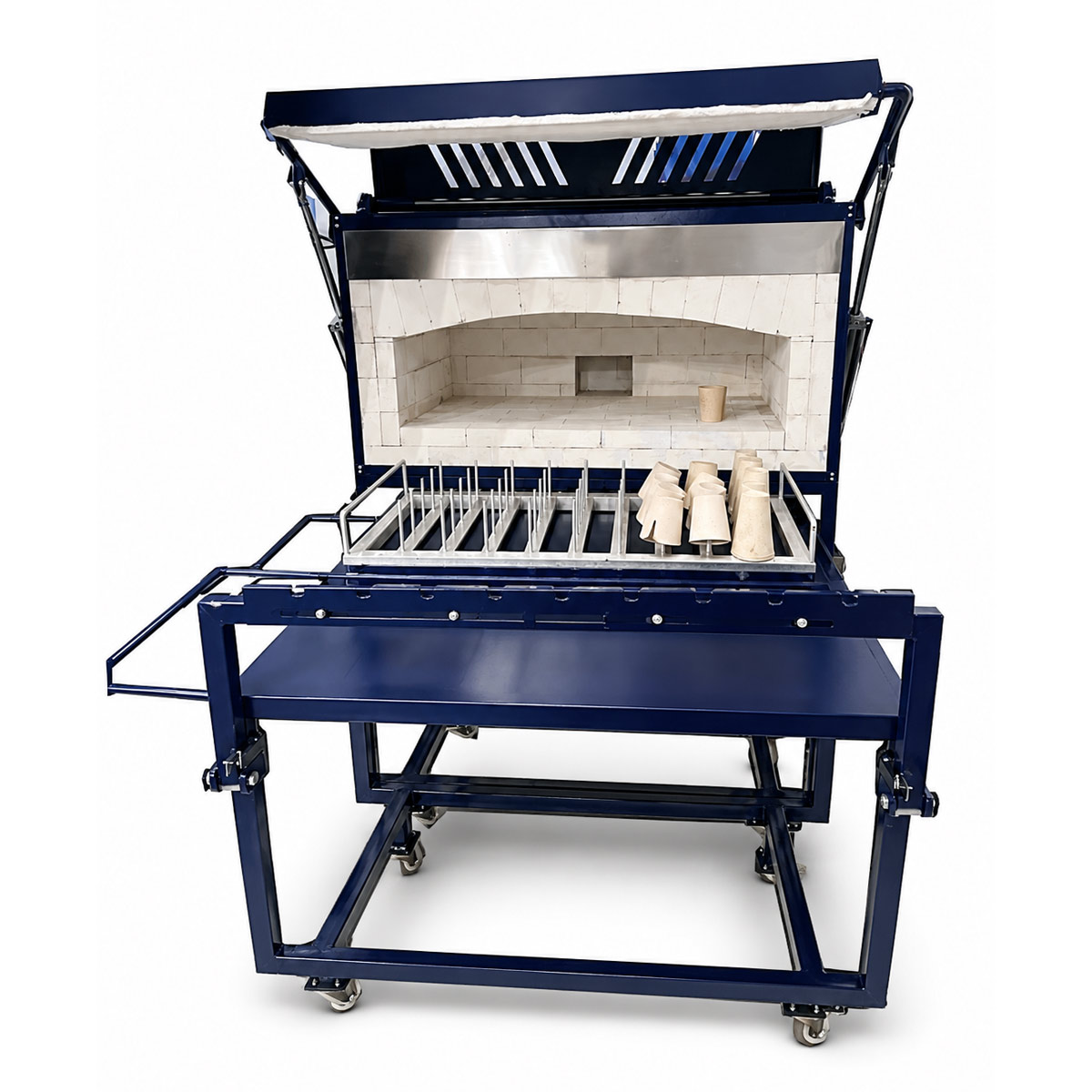
The Fire Assay Fusion Furnace is designed to melt pulverized ore samples with suitable flux mixtures at high temperature. Its large furnace chamber accommodates multiple crucibles in a single operating cycle, while automatic temperature control provides stable conditions for demanding fire assay laboratories.
- Fire assay fusion: Designed for melting pulverized ore samples with suitable flux mixtures in refractory crucibles.
- High process temperature: Operates at temperatures up to 1200 °C.
- Automatic temperature control: Electronic control maintains stable furnace temperature throughout the process.
- K-type thermocouple: Continuously monitors the chamber temperature.
- Multi-crucible capacity: Large furnace chamber supports several crucibles within the same operating cycle.
- Electric heating option: High-quality silicon carbide heating elements provide efficient high-temperature heating.
- Gas heating option: Natural gas or LPG heating configuration is also available.
- Pneumatic vertical door: Foot-pedal operation simplifies loading and unloading; an external air compressor is required.
- Multiload and multipour compatibility: Suitable for integration with Liya Test fire assay handling systems.
- Modular furnace construction: Independent furnace muffle and base plate simplify replacement and maintenance.
- Thermal insulation: Alumina and aluminium-silicate refractory materials help reduce heat loss.
- Heavy-duty construction: The unit measures approximately 125 × 180 × 200 cm and weighs about 1100 kg.
| Product Code | Product Name | Max. Process Temperature (°C) | External Dimensions (cm) | Weight (kg) |
| LT-M1520 | Fusion Furnace | 1200 | 125 × 180 × 200 | 1100 |
What Is a Fire Assay Fusion Furnace?
The Fire Assay Fusion Furnace is designed to melt pulverized ore samples with suitable flux mixtures at high temperature. In fire assay laboratories, prepared samples and flux are placed into refractory crucibles and heated until a molten phase is produced.
Fusion is one of the principal sample-preparation stages used before subsequent fire assay operations. The LT-M1520 Fusion Furnace provides a large industrial-style chamber capable of processing multiple crucibles within the same operating cycle.
This configuration helps laboratories increase sample throughput while reducing repeated loading operations.
Automatic Temperature Control up to 1200 °C
The LT-M1520 operates at process temperatures up to 1200 °C. An electronic automatic temperature-control system manages furnace temperature during operation.
A K-type thermocouple continuously monitors the internal temperature and provides feedback to the control system. Stable temperature conditions help laboratories apply more consistent fusion parameters across different sample batches.
Liya Test specifically identifies fast and accurate temperature control as one of the key features of the furnace.
Electric and Gas Heating Options
The Fusion Furnace is available with different heating configurations.
The electric version uses high-quality silicon carbide heating elements. These elements are suitable for the elevated temperatures required in fire assay fusion applications.
Liya Test also lists a Natural Gas/LPG heating system as an alternative configuration. Therefore, laboratories can select the heating arrangement according to their available energy infrastructure and operating requirements.
Large Multi-Crucible Furnace Chamber
The furnace chamber is designed for industrial-scale laboratory operation and can accommodate multiple crucibles.
Processing several crucibles within the same heating cycle can increase throughput in laboratories handling large numbers of ore samples. The furnace is also designed to work with multiload and multipour systems, allowing it to be integrated into a broader fire assay workflow.
Liya Test does not publish a fixed crucible quantity for LT-M1520, so we should not write values such as 24, 30 or 50 pots unless production gives us the exact configuration.
Pneumatic Vertical Door
The furnace uses a vertically lifting pneumatic door controlled by a foot pedal. This arrangement allows the operator to open or close the furnace while keeping both hands available for sample-handling equipment.
The pneumatic system requires an external air compressor. The vertical opening configuration also supports compatibility with pot loaders, pouring systems and other fire assay handling accessories.
Modular Furnace Construction
The LT-M1520 uses an independent furnace muffle and replaceable plate arrangement. This modular design simplifies maintenance when internal furnace components require inspection or replacement.
The furnace door incorporates refractory materials based on alumina and aluminium silicate, which provide thermal insulation at high operating temperatures.
The external structure uses a heavy-duty metal frame with an electrostatically coated surface for industrial laboratory use.
Fire Assay Laboratory Integration
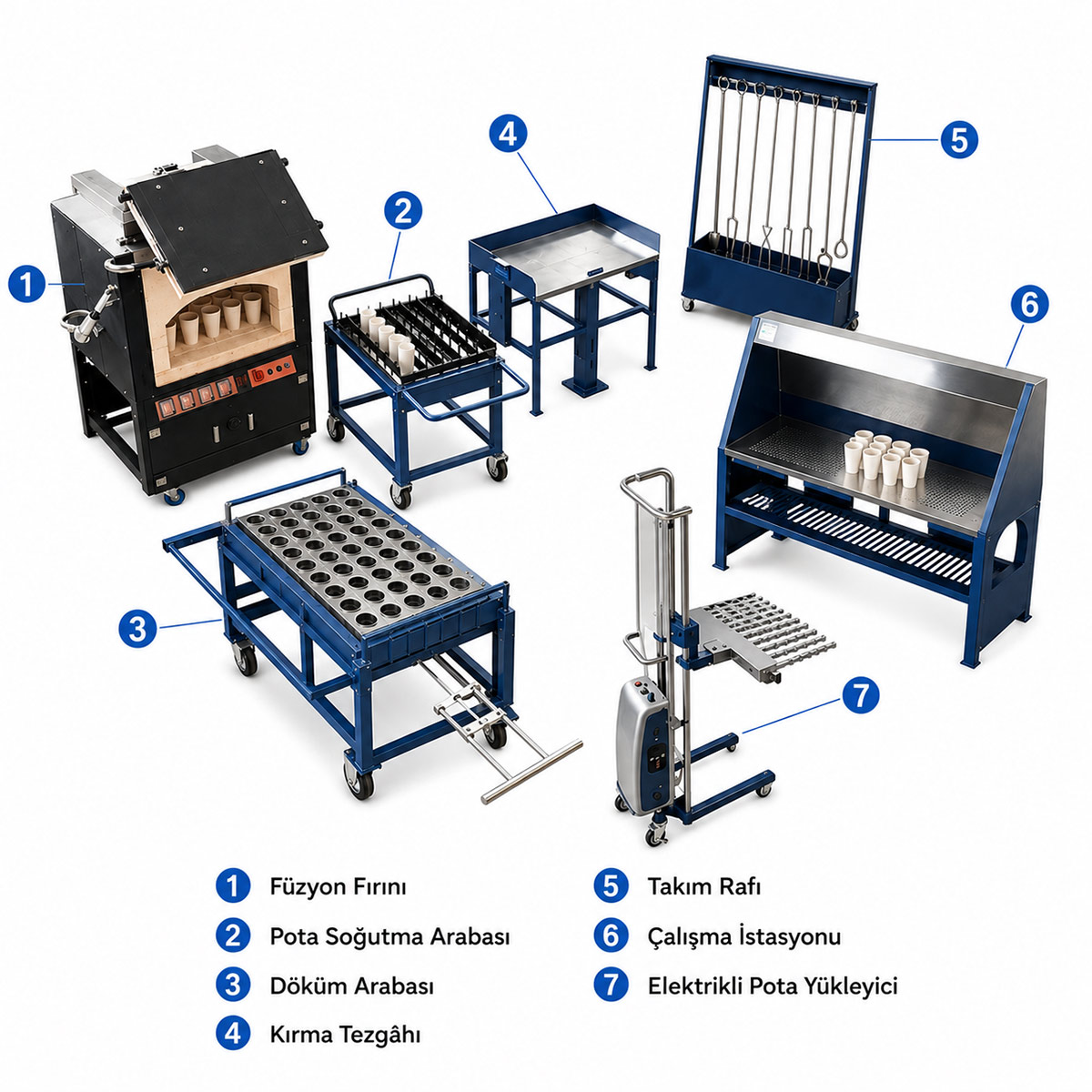
The Fusion Furnace can operate as part of a larger fire assay sample-handling system. Liya Test supplies compatible equipment such as pot loaders, pouring trolleys, pot cooling racks, pouring moulds, furnace rakes and furnace shovels.
Multiload and multipour systems are intended to reduce repeated manual handling and improve workflow around high-temperature furnaces.
LT-M1520 Technical Construction
The LT-M1520 Fusion Furnace has external dimensions of approximately 125 × 180 × 200 cm and weighs approximately 1100 kg.
Its substantial construction is intended for intensive fire assay laboratory operation. Because the manufacturer does not publish one universal electrical power rating or gas-consumption figure on the current product page, those values should be confirmed according to the selected heating configuration before installation.
Overall, the Fire Assay Fusion Furnace combines a 1200 °C process temperature, automatic electronic control, multi-crucible chamber, pneumatic vertical door and electric or gas heating options. Therefore, mineral and precious-metal laboratories can integrate the LT-M1520 into high-throughput fire assay sample preparation workflows.