
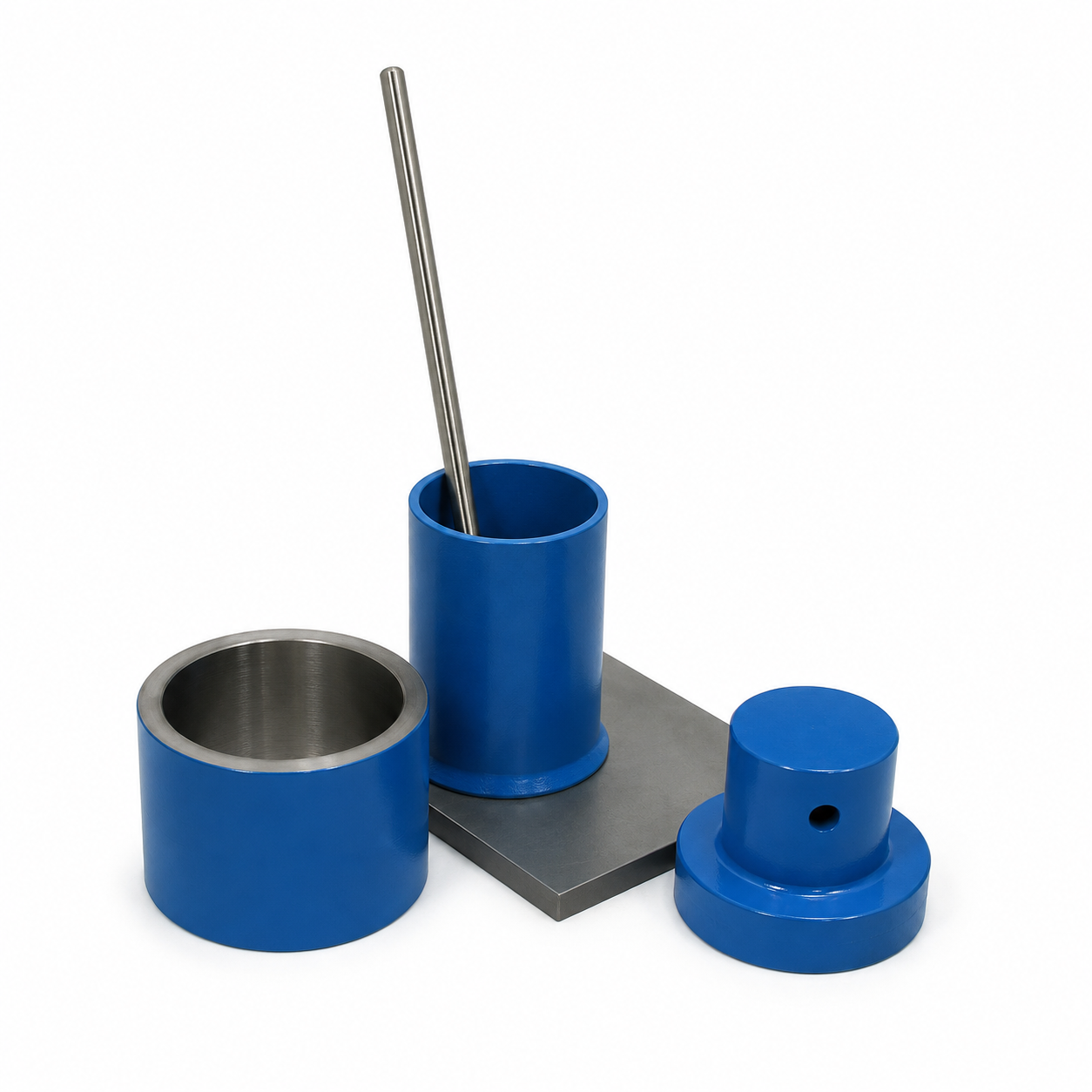
Aggregate Crushing Value Test Set
STANDART:BS 812:110-111
LT-A0064 Aggregate Crushing Value Test Set
LT-A0064/1 Steel Cylinder
LT-A0064/2 Base Plate
LT-A0064/3 Plunger
LT-A0064/4 Cylindrical Measure
LT-G0162 Tamping Rod
LT-A0065 Aggregate Crushing Value Test Set | Ø 150
LT-A0065/1 Steel Cylinder
LT-A0065/2 Base Plate
LT-A0065/3 Plunger
LT-A0065/4 Cylindrical Measure
LT-G0163 Camping Rod
Aggregate Crushing Value Test Set determines the resistance of aggregates to crushing under a gradually applied compressive load. The resulting Aggregate Crushing Value (ACV) provides a numerical indication of the mechanical strength of the aggregate. The product range includes Ø75 mm and Ø150 mm models for different aggregate sizes and laboratory requirements.
- Aggregate Strength Testing: Determines resistance of aggregate particles to crushing under compression.
- ACV Determination: Supports calculation of the Aggregate Crushing Value.
- Two Model Options: Available in Ø75 mm and Ø150 mm configurations.
- Ø75 mm Model: Designed for testing aggregates smaller than 10 mm.
- Complete Test Assembly: Includes steel cylinder, plunger, base plate, cylindrical measure and tamping rod.
- Rigid Steel Construction: Provides stable loading conditions during testing.
- Corrosion Protection: Components are protected by suitable coating or galvanizing.
- Ø75 mm Model: 120 × 120 × 350 mm, approximately 8.5 kg.
- Ø150 mm Model: 250 × 250 × 600 mm, approximately 32 kg.
- Standards: BS 812-110, BS 812-111
| Product Code | Product Name | Dimensions (mm) | Weight (kg) |
| LT-A0064 | Aggregate Crushing Value Test Set, Ø75 mm | 120 × 120 × 350 | 8.5 |
| LT-A0065 | Aggregate Crushing Value Test Set, Ø150 mm | 250 × 250 × 600 | 32 |

LT_AGREGAKIRILMA_
What Is an Aggregate Crushing Value Test Set?
The Aggregate Crushing Value Test Set determines the resistance of aggregates to crushing under a gradually applied compressive load. The test produces the Aggregate Crushing Value, or ACV, which provides a numerical indication of aggregate mechanical strength.
Aggregate strength is important in road construction, concrete production and other applications where particles are subjected to repeated mechanical loads. A lower ACV generally indicates greater resistance to crushing.
Ø75 mm and Ø150 mm Models
LİYA Test offers two different configurations.
The LT-A0064 model uses a Ø75 mm test assembly and is intended for smaller aggregate fractions. Its overall dimensions are 120 × 120 × 350 mm, and the complete unit weighs approximately 8.5 kg.
The LT-A0065 model uses the standard Ø150 mm configuration. Its dimensions are 250 × 250 × 600 mm, with an approximate weight of 32 kg.
This model range allows laboratories to select the apparatus according to aggregate particle size and the applicable test procedure.
Complete Aggregate Crushing Test Assembly
Each test set consists of a steel cylinder, plunger, base plate, cylindrical measure and tamping rod.
The steel cylinder contains the prepared aggregate sample during loading. The plunger transfers the compressive force evenly onto the material.
The base plate supports the cylinder and maintains a stable test arrangement. The cylindrical measure helps prepare a consistent sample quantity, while the tamping rod allows the aggregate to be placed in a repeatable manner.
How Is the Aggregate Crushing Value Test Performed?
First, the operator prepares the aggregate fraction required by the applicable method.
The sample is placed into the cylindrical measure and then transferred to the test cylinder in controlled layers. Each layer is compacted with the appropriate tamping rod.
The plunger is positioned on top of the aggregate. A compression testing machine then applies the required load progressively.
After loading, the crushed aggregate is removed and sieved through the specified test sieve.
The mass of material passing through the sieve is compared with the original specimen mass. The resulting percentage is reported as the Aggregate Crushing Value.
Evaluation of ACV Results
A lower ACV indicates that the aggregate resisted the applied crushing load more effectively. A higher value indicates greater particle breakdown.
The laboratory should compare results obtained from materials prepared and tested under the same conditions.
Aggregate Crushing Value should also be considered together with other properties such as abrasion resistance, fragmentation resistance, particle density and water absorption when evaluating overall material performance.
BS 812-110 and BS 812-111 Testing
BS 812-110 describes the determination of the Aggregate Crushing Value for aggregates subjected to a gradually applied compressive load.
Where materials require an alternative strength assessment, BS 812-111 describes the Ten Percent Fines Value procedure.
The Aggregate Crushing Value Test Set combines rigid steel components, complete sample preparation accessories and two size options. It therefore provides a practical solution for repeatable aggregate strength testing in quality-control and research laboratories.