
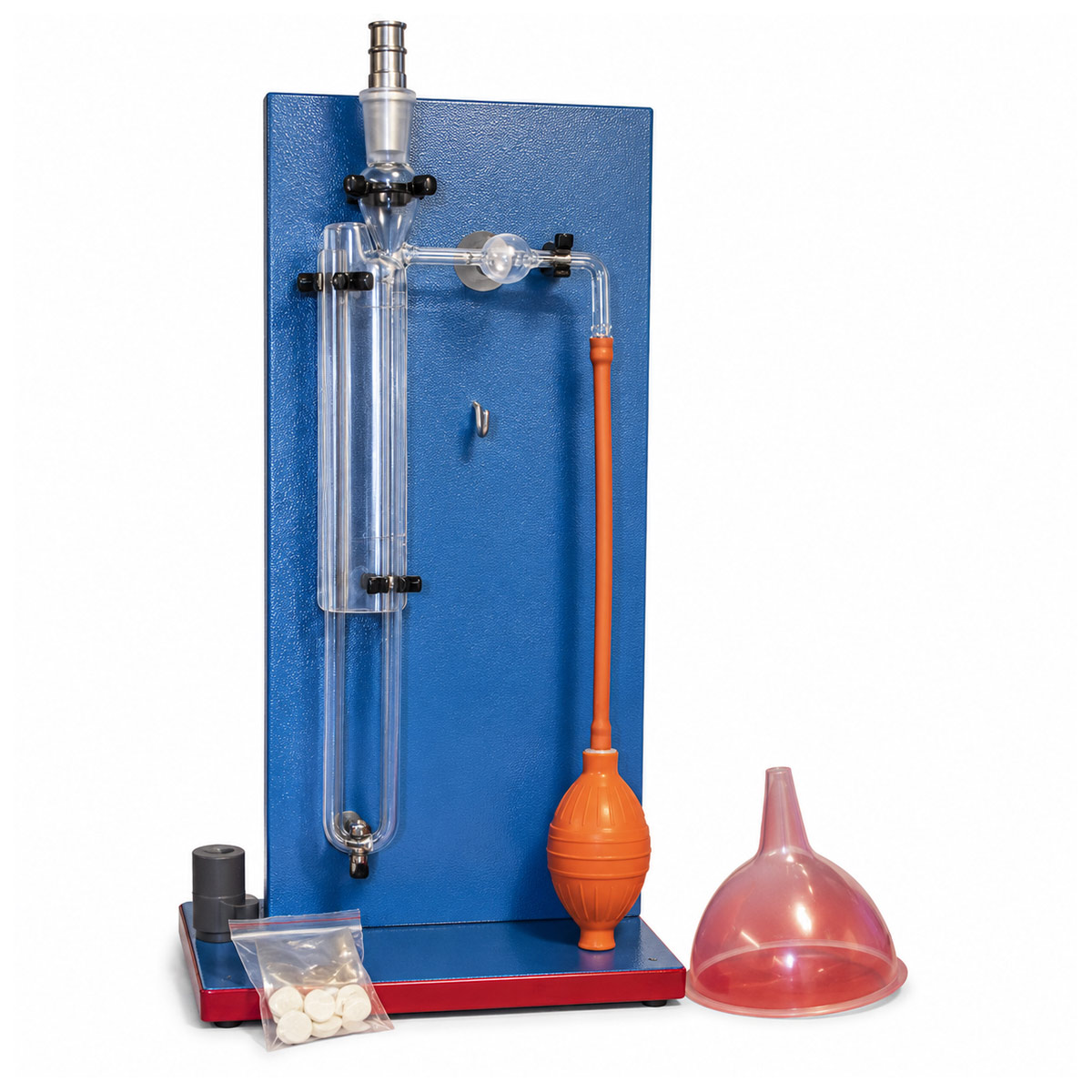
Blaine Permeability Apparatus
STANDART: TS EN 196-6; ASTM C204; AASHTO T153
LT-CE0005 Blaine Permeability Apparatus
LT-CE0005/1 U Tube Manometer
LT-CE0005/2 Cell with Perforated Disc and Plunger
LT-CE0005/3 Manometer Liquid | 250ml
LT-CE0005/4 Rubber Aspirator Bulb
LT-G0129 Plastic Funnel | 100mm
LT-CE0005/5 Filter Paper | 100 Pack
LT-CE0005/6 Filter Paper | 100 Pack
LT-CE0005/7 Calibration Sand | 100ml x 2 Bottles
LT-CE0005/8 Blaine Glass
Blaine Permeability Apparatus is designed to determine the fineness of hydraulic cement in terms of specific surface area by the air-permeability method. The manual system uses a U-tube glass manometer, stainless steel permeability cell, perforated disc, plunger and rubber aspirator bulb. The air-flow time through a compacted cement bed is measured and evaluated using calibration data from a reference material.
- Manual Blaine Testing: Measures air-flow time through a compacted cement bed.
- Specific Surface Measurement: Results can be expressed in cm²/g or m²/kg.
- U-Tube Manometer: Allows the liquid-level movement and test interval to be observed directly.
- Stainless Steel Test Cell: Includes the permeability cell, plunger and perforated disc.
- Rubber Aspirator Bulb: Creates the required pressure difference in the manometer.
- Manometer Liquid: Supplied in a 250 ml bottle.
- Plastic Funnel: 100 mm funnel supports clean specimen preparation.
- Filter Papers: Available in packs of 100 or 1000 pieces.
- Calibration Material: 100 ml × 2 bottles of calibration sand are available separately.
- Compact Design: 170 × 220 × 470 mm.
- Weight: Approximately 8 kg.
- Product Code: LT-CE0005.
- Standard Support: EN 196-6, ASTM C204 and AASHTO T153.
| Product Code | Product Name | Dimensions (mm) | Weight (kg) |
| LT-CE0005 | Blaine Permeability Apparatus | 170 × 220 × 470 | 8 |

Blaine Permeability Apparatus for Cement Fineness Testing
The Blaine Permeability Apparatus determines the fineness of hydraulic cement by measuring its specific surface area through air permeability. A prepared cement bed is compacted to a defined condition, and a controlled volume of air passes through the specimen.
The time required for the air to pass through the cement bed is measured and compared with calibration data from a reference material. This method is widely used for monitoring cement grinding consistency.
Manual U-Tube Manometer System
The apparatus uses a U-tube glass manometer mounted vertically on a rigid stand. The manometer contains a suitable low-viscosity liquid.
A rubber aspirator bulb raises the liquid to the required starting position. Once the pressure difference is created, air begins to flow through the compacted cement specimen.
The operator records the time required for the manometer liquid to move between the specified marks.
Stainless Steel Permeability Cell
The test assembly includes a stainless steel permeability cell, perforated disc and plunger. Filter paper is positioned above the perforated disc before the cement sample is introduced.
The plunger compacts the specimen to the required bed volume. Consistent specimen preparation is important because changes in bed porosity directly affect air-flow time. ASTM C204-26 specifies this type of manually operated apparatus as the reference Blaine method.
Calibration with Reference Material
The Blaine method is comparative. Therefore, the apparatus must be calibrated using an appropriate reference material.
Liya Test supplies LT-CE0005/7 Calibration Sand in two 100 ml bottles as a separate accessory.
Calibration helps establish the apparatus constant used during specific-surface calculations.
What Does the Blaine Value Indicate?
Blaine fineness represents the total surface area of cement per unit mass. Results are commonly reported as cm²/g or m²/kg.
A higher Blaine value generally indicates a finer cement. However, the method does not directly determine individual particle sizes. EN 196-6 also notes that the method primarily supports consistency control of the grinding process.
EN 196-6 and ASTM C204 Testing
EN 196-6:2018 includes the Blaine air-permeability method as one of the standard techniques for determining cement fineness.
ASTM C204-26 covers both manually operated and qualified automated Blaine apparatus. For this LT-CE0005 manual model, the relevant reference approach is Test Method A.