
Percolation Columns
STANDART: –
LT-A0620 Percolation Columns
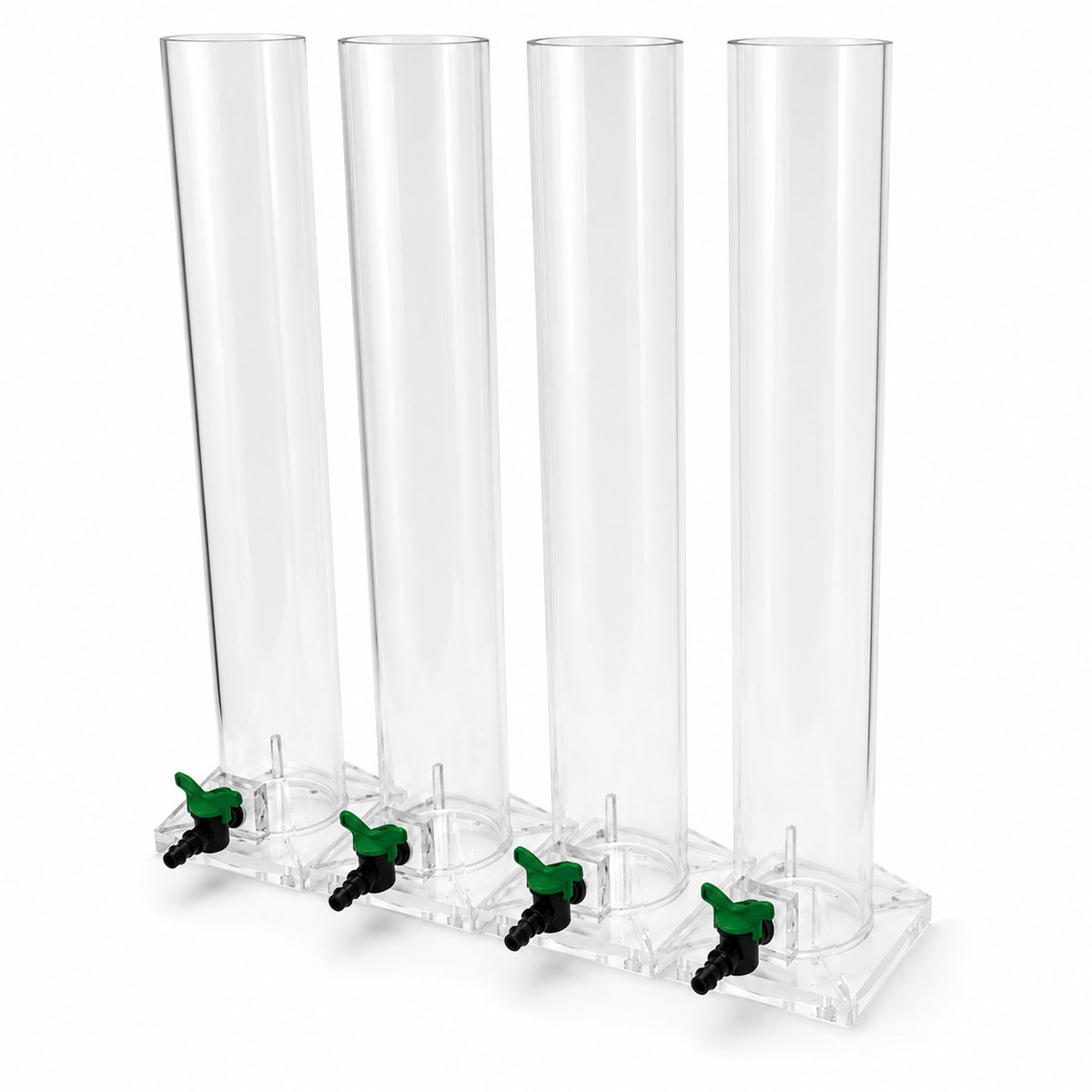
The Percolation Columns are designed to evaluate the permeability, drainage behaviour and settlement tendency of ore samples during laboratory-scale leaching studies. The system allows the operator to observe how water moves through the ore bed and how the bed height changes during wetting.
- Leaching research: Supports laboratory evaluation of ore behaviour during Au enrichment studies.
- Percolation assessment: Shows how easily liquid passes through the prepared ore bed.
- Drainage monitoring: The amount of liquid discharged from the bottom outlet can be measured over time.
- Settlement observation: Allows changes in ore-bed height after wetting to be monitored.
- Comparative testing: Different ore samples can be evaluated under similar laboratory conditions.
- Controlled water addition: Liquid is introduced from the upper section of the column.
- Bottom discharge outlet: Drainage volume can be collected and measured at selected time intervals.
- Compact laboratory construction: Suitable for mineral-processing and leaching research.
- External dimensions: Approximately 12 × 12 × 60 cm.
- Weight: Approximately 2 kg.
- Product code: LT-A0620.
| Product Code | Product Name | External Dimensions (cm) | Weight (kg) |
| LT-A0620 | Percolation Columns | 12 × 12 × 60 | 2 |
What Are Percolation Columns?
Percolation Columns are laboratory devices used to evaluate how liquid moves through a prepared ore bed. The system helps investigate permeability, drainage behaviour and settlement during mineral-processing and leaching studies.
The LT-A0620 Percolation Columns are particularly intended to support laboratory evaluation of ores during gold enrichment studies. Liya Test describes the equipment as a system for observing the resistance of the ore to drainage and its tendency to settle when exposed to water.
Evaluation of Ore Permeability
During the test, the operator places the prepared ore sample inside the column. Water is then introduced from the upper section until the selected test condition is reached.
The liquid moves through the voids between the ore particles and exits from the outlet at the bottom of the column. The discharged volume can be measured over a defined time interval.
This information helps the laboratory compare the permeability behaviour of different ore samples under controlled conditions.
Monitoring Drainage Behaviour
The rate at which liquid leaves the column provides useful information about the internal flow characteristics of the ore bed.
Coarse and well-distributed material may allow liquid to pass more easily. In contrast, fine particles or compacted areas may restrict flow.
For comparative laboratory work, operators should maintain consistent sample preparation, liquid addition and measurement intervals between individual tests.
Settlement of the Ore Bed
Water can also change the arrangement of particles inside the column.
As the ore becomes wet, particles may rearrange and the total bed height may decrease. The operator can record the initial height and compare it with later measurements to observe settlement behaviour.
Liya Test specifically identifies this change in height as one of the main observations performed with the Percolation Columns.
Laboratory Leaching Applications
Percolation behaviour can be useful when evaluating ores intended for leaching studies. A laboratory may compare different particle-size distributions, ore types or preparation conditions before performing further processing work.
The LT-A0620 therefore provides a simple method for observing liquid flow and physical changes within a vertical ore bed.
LT-A0620 Technical Construction
The LT-A0620 Percolation Columns have external dimensions of approximately 12 × 12 × 60 cm and a weight of approximately 2 kg.
The current Liya Test product pages do not specify a fixed sample capacity, construction material or electrical requirement. These values should therefore be confirmed separately if they are required for a project specification.
Overall, the Percolation Columns provide a compact laboratory system for evaluating ore permeability, drainage and settlement behaviour during controlled leaching studies.