
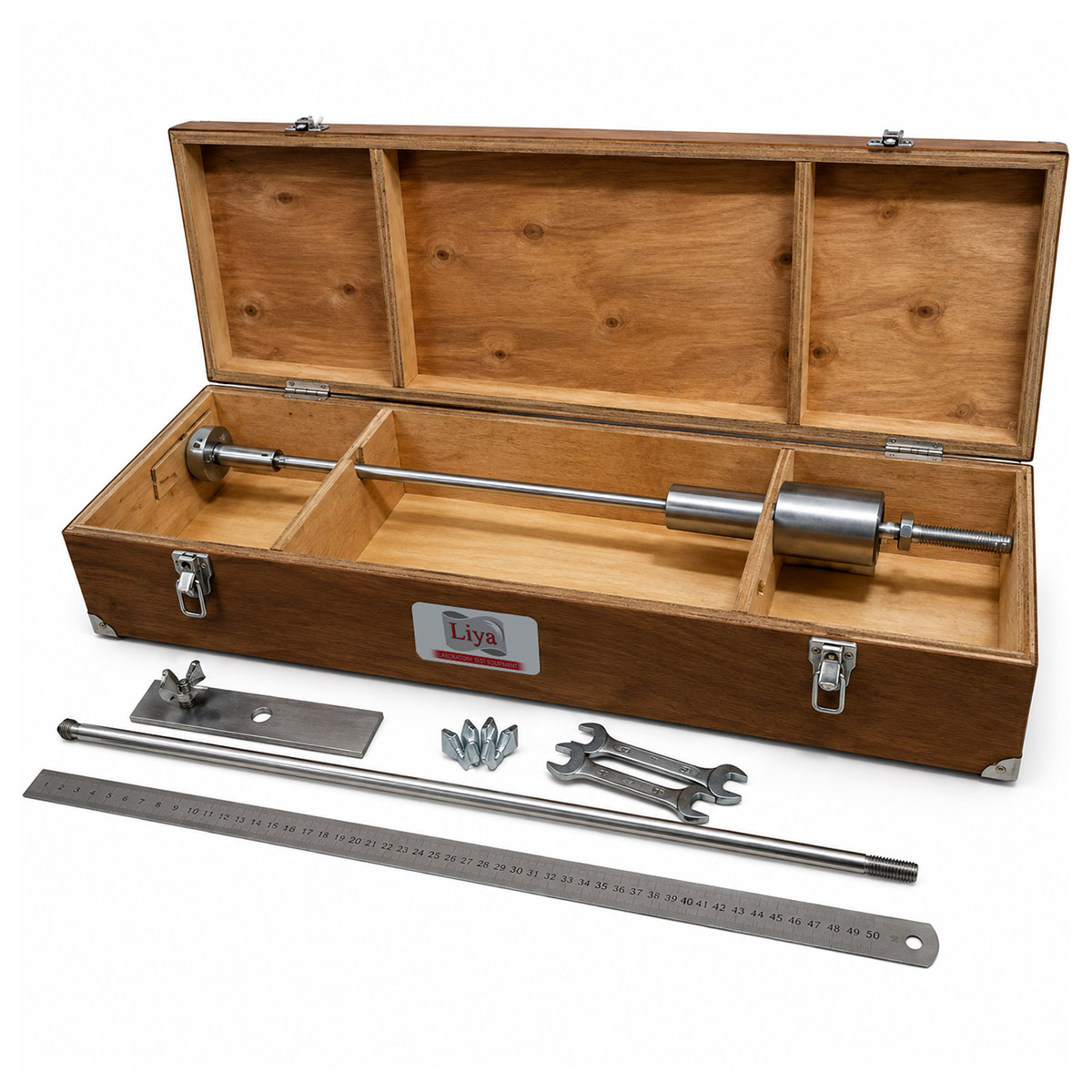
The Dynamic Cone Penetrometer (DCP) is designed for rapid in-situ assessment of the penetration resistance and strength characteristics of subgrade, sub-base and compacted pavement materials. The LT-S0047 uses an 8 kg sliding hammer with a 575 mm drop height to drive a 60° cone into the ground. Standard measurements can be performed to approximately 850 mm depth, while extension rods allow testing to depths of up to 2 m.
- In-situ soil assessment: Evaluates subgrade, sub-base and compacted materials directly in the field.
- 8 kg sliding hammer: Standard test configuration uses an 8 kg hammer.
- 575 mm drop height: Provides repeatable impact energy during penetration.
- 60° cone tip: Transfers impact energy into the soil through the penetration rod.
- Penetration index: Penetration per blow can be recorded throughout the test.
- Standard testing depth: Measurements can be performed to approximately 850 mm.
- Extended testing depth: Extension rods allow measurements to approximately 2 m.
- Estimated in-situ CBR: Suitable correlations may be used to estimate field CBR.
- Layer identification: Changes in penetration rate help identify variations in pavement and soil layers.
- Rapid field testing: A typical test can be completed within a short period.
- Steel measuring rule: Supports direct monitoring of penetration depth.
- Complete hammer assembly: Includes hammer, guide, anvil and handle components.
- Extension rods: Upper and lower extension rods are included.
- Portable system: Supplied with a wooden carrying case.
- External dimensions: 120 × 35 × 20 cm.
- Approximate weight: 30 kg.
- Product code: LT-S0047.
| Product Code | Product Name | External Dimensions (cm) | Weight (kg) |
| LT-S0047 | Dynamic Cone Penetrometer | 120 × 35 × 20 | 30 |

What Is a Dynamic Cone Penetrometer?
The Dynamic Cone Penetrometer (DCP) is a portable field testing instrument used to evaluate the in-situ penetration resistance and strength characteristics of soils and pavement materials.
The system provides a rapid method for investigating subgrade, sub-base, granular pavement layers and compacted soils without requiring extensive excavation.
During testing, a sliding hammer repeatedly strikes an anvil connected to a penetration rod. The cone at the lower end of the rod advances into the ground after each impact. The operator records the amount of penetration produced by each blow.
Changes in penetration rate provide useful information about differences in material resistance and layer conditions.
The LT-S0047 Dynamic Cone Penetrometer follows the classic DCP configuration associated with the Kleyn, Maree and Savage design. LİYA specifies an 8 kg hammer, 575 mm drop height and 60° cone tip for the system.
8 kg Hammer and 575 mm Drop Height
The LT-S0047 uses an 8 kg sliding hammer.
During a test, the operator raises the hammer along the guide rod and releases it from a height of 575 mm. The hammer strikes the anvil, transferring impact energy through the penetration rod to the cone.
This process is repeated while penetration is recorded.
The current ASTM D6951/D6951M-18(2023) specifically covers Dynamic Cone Penetrometer testing using an 8 kg hammer for shallow pavement applications. ASTM defines the test as a method for measuring penetration rate through undisturbed soils, compacted materials or both.
60° Cone Penetration System
A 60° cone tip is mounted at the lower end of the penetration rod.
Each hammer blow drives the cone further into the material. The operator records the cumulative depth or the penetration obtained per hammer blow.
The resulting value is often expressed as a DCP penetration rate, typically representing penetration distance per blow.
Lower penetration per blow generally indicates a more resistant layer, while greater penetration can indicate softer or less resistant material.
However, penetration response also depends on material type, moisture content, density and particle-size distribution.
In-Situ CBR Estimation
The Dynamic Cone Penetrometer does not perform a conventional laboratory CBR test.
Instead, the device measures penetration rate under field conditions. Suitable empirical correlations can then be used to estimate an in-situ California Bearing Ratio (CBR).
ASTM D6951/D6951M states that penetration data from the 8 kg DCP can be used to estimate in-situ CBR and to assess layer thickness and other material characteristics.
An important distinction should be maintained: a DCP-derived field CBR will not necessarily match a laboratory or soaked CBR value obtained from the same material. ASTM specifically describes the method as an assessment of strength under existing field conditions.
Detection of Layer Changes
One major advantage of DCP testing is its ability to show changes in material resistance with depth.
As the cone passes through different layers, penetration per blow can change significantly. A stiff or well-compacted layer may produce a low penetration rate, while a weaker layer may allow the cone to advance more quickly.
Plotting penetration against depth can therefore help identify:
- changes between pavement layers,
- weak or under-compacted zones,
- variation within subgrade material,
- and approximate layer boundaries.
ASTM also recognizes DCP testing as a method for evaluating the strength characteristics of both fine- and coarse-grained soils, granular construction materials and weak stabilized materials.
Standard and Extended Testing Depth
LİYA specifies a standard measurement depth of approximately 850 mm for the LT-S0047.
When deeper investigation is required, extension rods can be connected to the system. The product configuration allows penetration measurements to be extended to approximately 2 metres.
ASTM D6951/D6951M typically describes use of the 8 kg DCP to around 1000 mm below the surface and also permits the use of drive-rod extensions.
However, ASTM highlights an important limitation: adding extension rods changes the mass and inertia of the apparatus and can introduce additional skin friction along the rods. Therefore, established CBR or strength correlations should only be applied when they are appropriate for the actual DCP configuration.
ASTM D6951/D6951M-18(2023)
The current active ASTM reference is:
ASTM D6951/D6951M-18(2023) — Standard Test Method for Use of the Dynamic Cone Penetrometer in Shallow Pavement Applications.
The method covers penetration-rate measurement using an 8 kg DCP through undisturbed soils and compacted materials. ASTM identifies applications including estimation of in-situ CBR, determination of strata thickness and evaluation of material strength characteristics.
This standard is a particularly strong match for LT-S0047 because its primary mechanical configuration matches the 8 kg DCP arrangement.
BS 1377-9:2025
The existing LİYA page currently lists BS 1377:9 without an edition year.
The current edition is BS 1377-9:2025 — Methods of test for soils for civil engineering purposes — In-situ tests.
BSI published this edition on 20 November 2025. Its scope explicitly includes an additional method for determining in-situ penetration resistance using the dynamic cone penetration test.
The old BS 1377-9:1990 remained current until 20 November 2025 and has now been superseded by the 2025 edition.
Therefore, the new website should use:
BS 1377-9:2025
instead of the generic old BS 1377:9 reference.
Complete Field Testing System
The LT-S0047 is supplied as a complete portable field-testing system.
The current LİYA configuration includes the penetration hammer assembly, penetration rod, cone tip, measuring components, upper and lower extension rods, hand tools, steel ruler and wooden carrying case.
The complete set has external dimensions of approximately 120 × 35 × 20 cm and weighs around 30 kg.
Overall, the Dynamic Cone Penetrometer provides a rapid and practical solution for evaluating changes in the in-situ strength of soils and pavement materials. Its 8 kg hammer, 575 mm drop height, 60° cone and extendable penetration system make it particularly suitable for road, subgrade and geotechnical field investigations.