
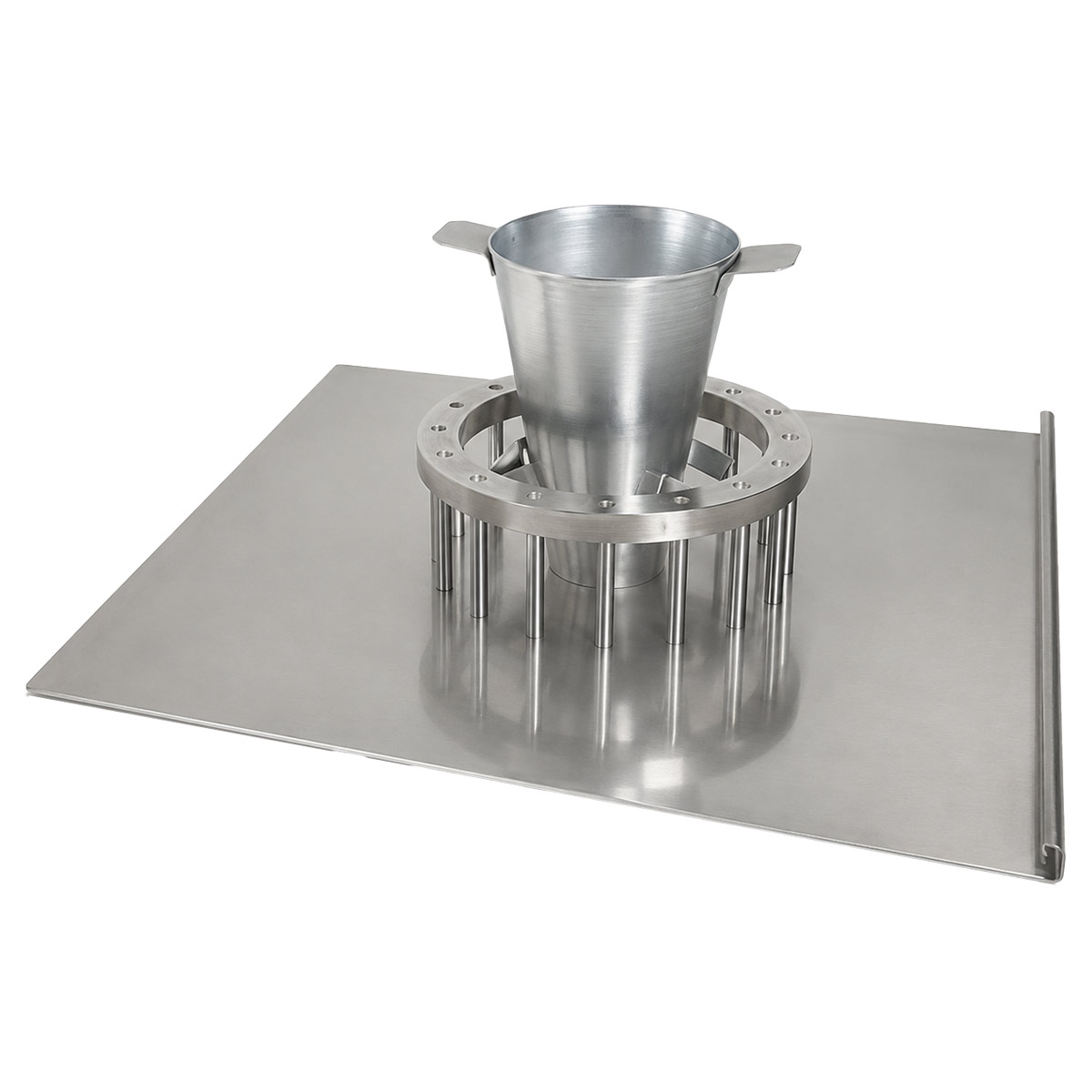
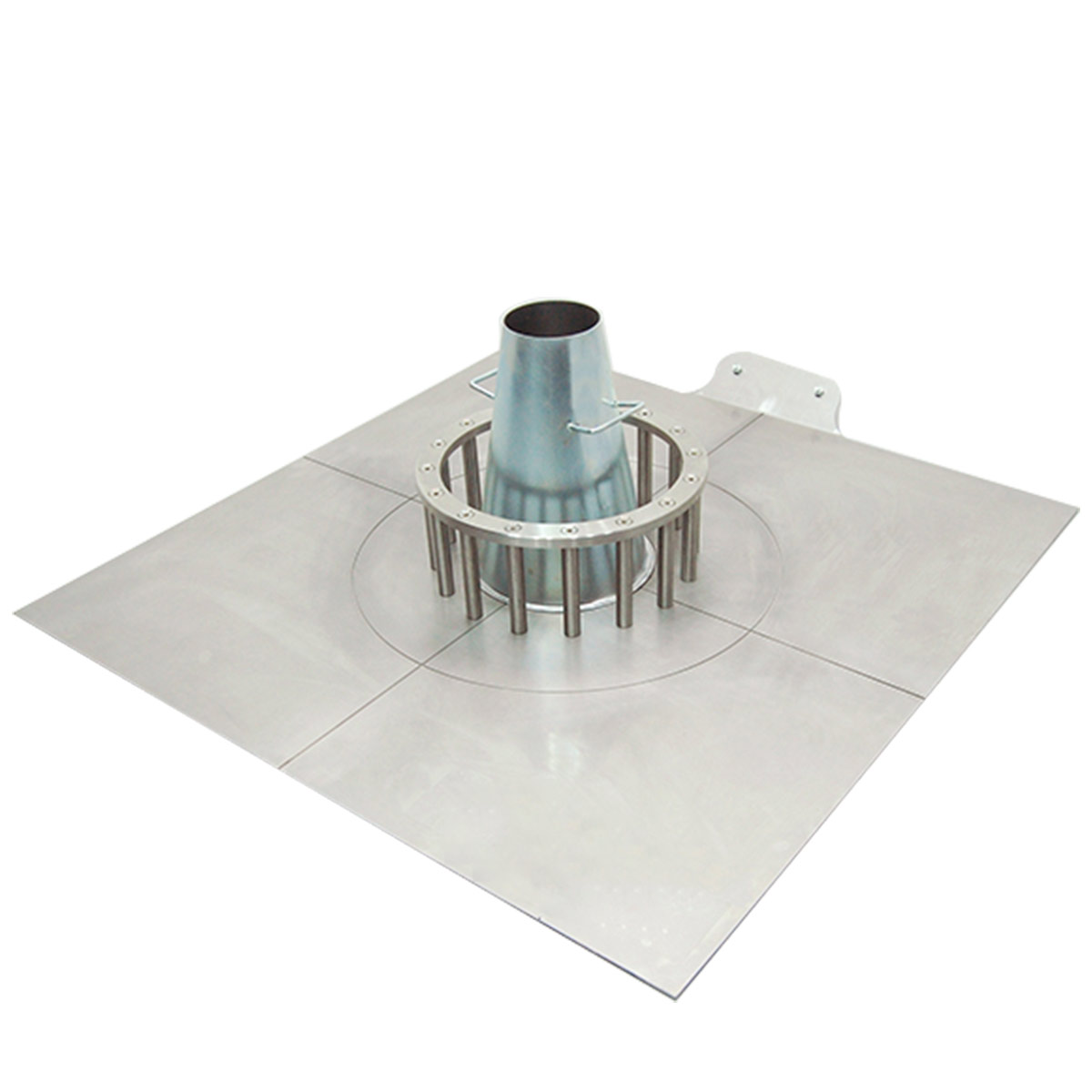
J-Ring Test Set evaluates the passing ability of self-compacting concrete (SCC) through reinforcement-like obstacles. The closely spaced stainless-steel bars simulate congested reinforcement and allow laboratories to observe the flow and potential blocking behaviour of fresh concrete. The test allows users to determine the spread diameter, t500J flow time and blocking step. The complete system includes a J-Ring, standard slump cone and a large stainless-steel base plate.
- Product Code: LT-C0058
- Product Name: J-Ring Test Set
- Application: Passing ability testing of self-compacting concrete
- Concrete Type: Self-Compacting Concrete (SCC)
- Barrier System: 16 × Ø18 mm stainless-steel bars
- Spread Measurement: Determines concrete spread after passing through the barrier
- t500J Measurement: Records the time required to reach 500 mm spread
- Blocking Evaluation: Compares concrete heights inside and outside the J-Ring
- Base Plate: 900 × 900 mm stainless-steel plate
- Reference Markings: Ø200 mm and Ø500 mm
- Slump Cone: Ø100 mm top, Ø200 mm bottom, 300 mm height
- Construction: Durable stainless-steel components
- Standards: EN 12350-12, EN 12350-8
| Technical Specification | LT-C0058 |
| Product Name | J-Ring Test Set |
| Application | SCC Passing Ability Test |
| Barrier Bars | 16 × Ø18 mm Stainless Steel |
| Base Plate Dimensions | 900 × 900 mm |
| Base Plate Markings | Ø200 mm and Ø500 mm |
| Slump Cone – Top Diameter | Ø100 mm |
| Slump Cone – Bottom Diameter | Ø200 mm |
| Slump Cone Height | 300 mm |
| Measured Parameters | Spread Diameter, t500J Time, Blocking Step |
| Standards | EN 12350-12, EN 12350-8 |

LT_BETON_JRING
What Is a J-Ring Test Set?
The J-Ring Test Set evaluates the passing ability of self-compacting concrete through reinforcement-like obstacles. During the test, fresh concrete flows between vertical steel bars under its own weight. Therefore, laboratories can observe both the flow performance and potential blocking behaviour of the mixture.
High flowability alone does not guarantee good SCC performance. The concrete must also pass through congested reinforcement without excessive aggregate accumulation. The J-Ring method provides a practical way to compare this behaviour.
Closely Spaced Barrier System
The J-Ring contains 16 stainless-steel bars with a diameter of Ø18 mm. These bars simulate the restricted spaces found in heavily reinforced concrete structures.
As the concrete moves through the barrier, coarse aggregate and mortar must flow together. If the mixture has poor passing ability, aggregate may accumulate around the bars. As a result, the spread can decrease and the blocking step can increase.
The stainless-steel construction also supports frequent laboratory use and simplifies cleaning after testing.
How Is the J-Ring Test Performed?
First, the operator places the 900 × 900 mm base plate on a flat and stable surface. Next, the J-Ring is positioned over the centre marking. The slump cone is then placed in the middle of the ring.
The operator fills the cone with fresh self-compacting concrete. After preparation, the cone is lifted vertically without disturbing the mixture.
The concrete flows through the steel bars and spreads across the plate. The operator records the time required for the concrete to reach the 500 mm circle. This value is known as the t500J time.
Next, the operator measures the spread diameter in two perpendicular directions. Finally, concrete heights inside and outside the ring are compared to evaluate the blocking step.
Evaluation of Passing and Blocking Behaviour
A small height difference generally indicates that the concrete passes through the reinforcement more easily. In contrast, a larger difference may indicate a higher risk of blocking.
The spread diameter also provides useful information. A noticeable reduction compared with an unrestricted slump-flow test can show that the reinforcing bars restrict concrete movement.
However, laboratories should not evaluate the J-Ring result alone. Slump-flow, V-Funnel or L-Box results can provide additional information about filling ability, viscosity and passing behaviour.
Testing According to EN 12350-12
EN 12350-12 defines the J-Ring method for determining the passing ability of self-compacting concrete. The test includes measurements such as the blocking step, spread diameter and t500J time.
In addition, EN 12350-8 describes the slump-flow test and t500 flow time for self-compacting concrete without the J-Ring obstruction.
Therefore, laboratories can compare unrestricted and restricted flow behaviour to obtain a broader understanding of SCC performance.
Reliable SCC Passing Ability Evaluation
The J-Ring Test Set combines a stainless-steel barrier system, standard slump cone and large measuring plate in one practical test arrangement.
As a result, laboratories can evaluate the passing ability, spread behaviour and blocking tendency of self-compacting concrete in a controlled and repeatable manner.