
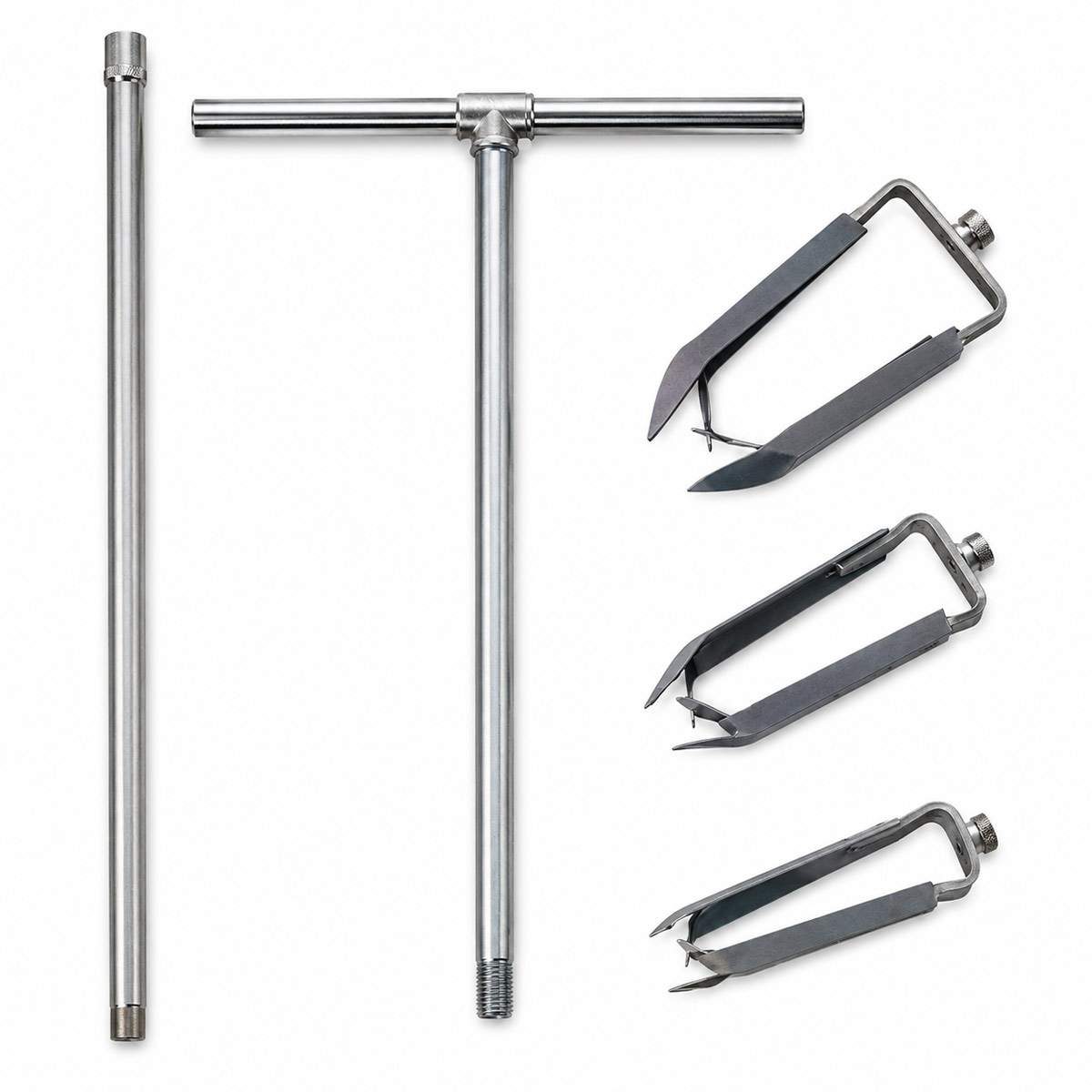
The Manual Soil Auger Set is designed for shallow soil exploration and the collection of disturbed soil samples in field applications. The set includes Ø80 mm, Ø100 mm and Ø150 mm auger heads, a 1 m T-handle and a 1 m extension rod. Depending on soil conditions and the number of extension rods used, the system can be operated to depths of up to approximately 5 metres.
- Manual soil sampling: Supports collection of disturbed soil samples during field investigations.
- Three auger diameters: Includes Ø80, Ø100 and Ø150 mm auger heads.
- T-handle: Supplied with a 1 metre T-type operating handle.
- Extension rod: Includes a 1 metre extension rod.
- Working depth: LİYA specifies operation to depths of up to approximately 5 m with a suitable configuration.
- Shallow soil exploration: Helps investigate changes in near-surface soil strata.
- Disturbed sampling: Suitable where preservation of the original soil structure is not required.
- Different soil conditions: The operator can select an auger diameter according to soil type and required sample quantity.
- Manual operation: Requires no electrical, hydraulic or pneumatic power.
- Field portability: Compact design simplifies transportation between sampling locations.
- Low maintenance: Mechanical construction requires minimal routine servicing.
- External dimensions: 110 × 20 × 20 cm.
- Approximate weight: 5 kg.
- Product code: LT-S0145.
| Product Code | Product Name | External Dimensions (cm) | Weight (kg) |
| LT-S0145 | Manual Soil Auger Set | 110 × 20 × 20 | 5 |

What Is a Manual Soil Auger Set?
The Manual Soil Auger Set is a portable field sampling system used for shallow soil exploration and the collection of disturbed soil samples.
The operator positions the selected auger head on the ground and rotates the T-handle manually. As the auger advances, soil enters the auger head and can then be brought to the surface for visual inspection or sample collection.
The LT-S0145 Manual Soil Auger Set requires no electrical or hydraulic power. This makes it suitable for geotechnical investigations, preliminary site surveys and field sampling at locations where powered drilling equipment is unnecessary or impractical.
Ø80, Ø100 and Ø150 mm Auger Heads
The LT-S0145 set includes three interchangeable auger heads:
- Ø80 mm
- Ø100 mm
- Ø150 mm
The user can select the most appropriate diameter according to soil conditions and the quantity of material required.
A smaller auger creates a narrower borehole and generally requires less manual effort. Larger auger heads allow a greater quantity of material to be recovered during each sampling interval.
However, actual performance depends on soil density, moisture condition, gravel content and the resistance encountered during drilling.
1 Metre T-Handle
The system includes a 1 metre T-type auger handle.
The T-shaped grip allows the operator to rotate the auger using both hands and transfer torque directly to the auger head.
Because the equipment operates completely manually, it does not require an electric motor, hydraulic power pack or compressed-air supply.
This simple design makes the set practical for rapid field investigations and sampling at multiple locations.
Extension Rod and Working Depth
A 1 metre extension rod is included with the standard set.
LİYA states that the Manual Soil Auger Set can be used to depths of up to approximately 5 metres when configured appropriately.
For deeper operation, additional extension rods would normally be required. Since the standard set description lists only one 1 m extension, the exact number of additional rods required for a 5 m configuration should be confirmed when specifying the delivery package.
Actual achievable depth also depends on groundwater conditions, soil characteristics and the equipment configuration. ASTM D1452/D1452M-25 specifically notes these factors as limitations of auger exploration depth.
Disturbed Soil Sampling
Manual auger sampling normally produces a disturbed soil sample.
The soil is removed from its original position during augering and therefore does not preserve its natural structure, orientation or in-situ stress condition.
However, disturbed samples remain useful for many laboratory applications.
ASTM D1452/D1452M-25 states that auger samples may generally be used for soil classification, compaction-characteristic testing and other procedures requiring bulk samples.
For tests requiring intact or relatively undisturbed specimens, a dedicated thin-walled tube sampling system should be selected instead.
Soil Layer Investigation
Auger borings can also help identify changes in soil conditions with depth.
The operator can inspect material recovered at successive intervals and observe changes in colour, texture, particle size or general soil type.
ASTM identifies auger boring as one of the simplest methods for shallow soil exploration and notes its usefulness for indicating changes in strata and supporting groundwater-level observations where conditions permit.
This makes the LT-S0145 useful not only for sample collection but also for preliminary site assessment.
ASTM D1452/D1452M-25
The current ASTM reference is:
ASTM D1452/D1452M-25 — Standard Practice for Soil Exploration and Sampling by Auger Borings
ASTM lists the 2025 edition as Active. The practice covers equipment and procedures for using earth augers in shallow-depth geotechnical exploration.
The standard does not apply to hollow-stem auger drilling systems, which fall under a different ASTM practice.
For the LT-S0145, ASTM D1452/D1452M-25 is therefore a strong technical reference because the device is specifically intended for manual auger boring and disturbed soil sampling.
Compact Field Sampling System
The LT-S0145 measures approximately 110 × 20 × 20 cm and weighs around 5 kg according to LİYA’s technical table.
Its lightweight and fully mechanical construction allows the system to be transported easily between sampling points.
Overall, the Manual Soil Auger Set provides a simple and practical solution for shallow soil exploration, disturbed sample collection and preliminary investigation of soil strata in field applications.