
Pycnometers | Bottle Type
STANDART: TS EN 1097-6
LT-G0070 Bottle Type Pycnometer | 500ml
LT-G0071 Bottle Type Pycnometer | 1000ml
LT-G0072 Bottle Type Pycnometer | 2000ml
LT-G0073 Bottle Type Pycnometer | 3000ml
LT-G0074 Bottle Type Pycnometer | 5000ml
LT-G0114 Glass Filling Head for Bottle Type Pycnometer
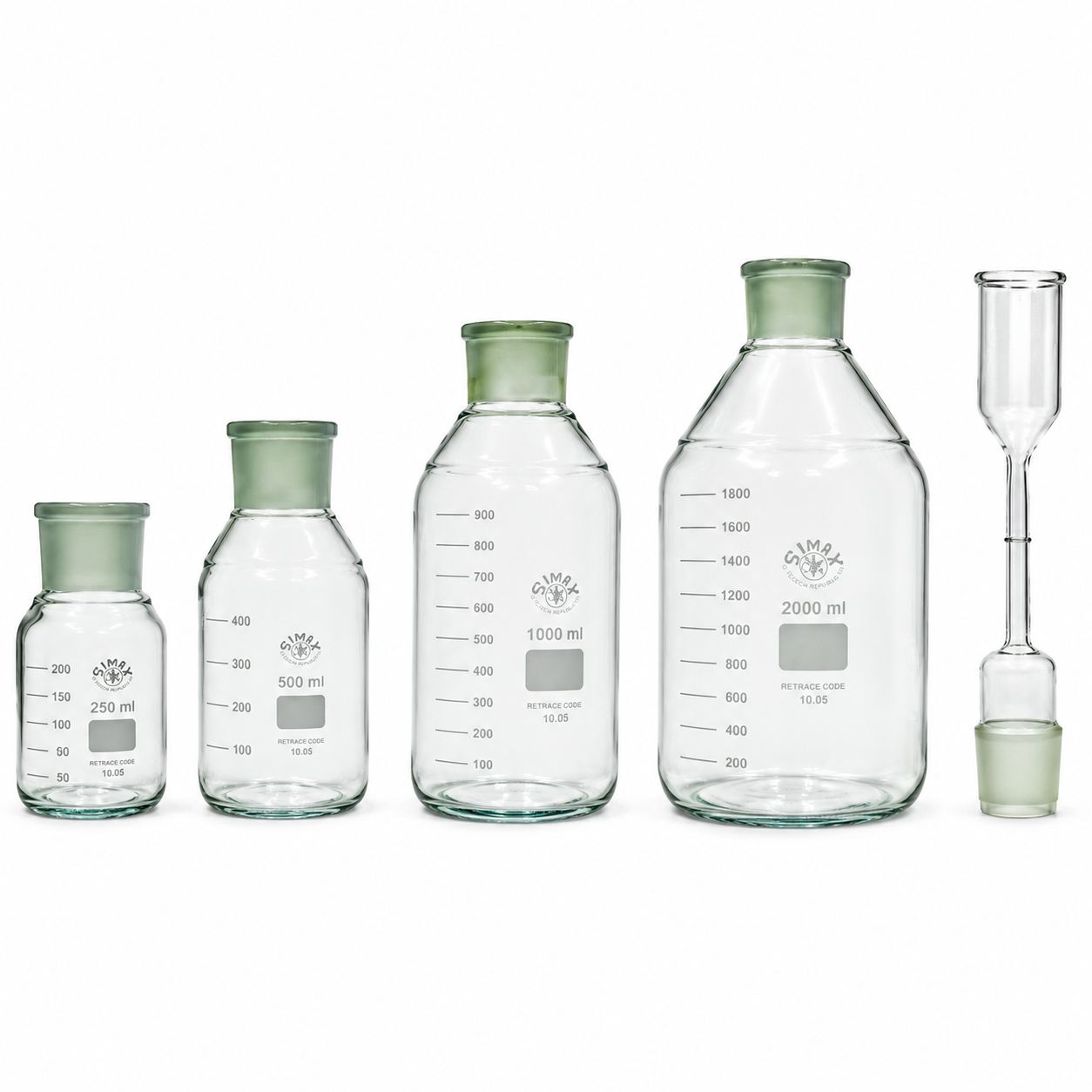
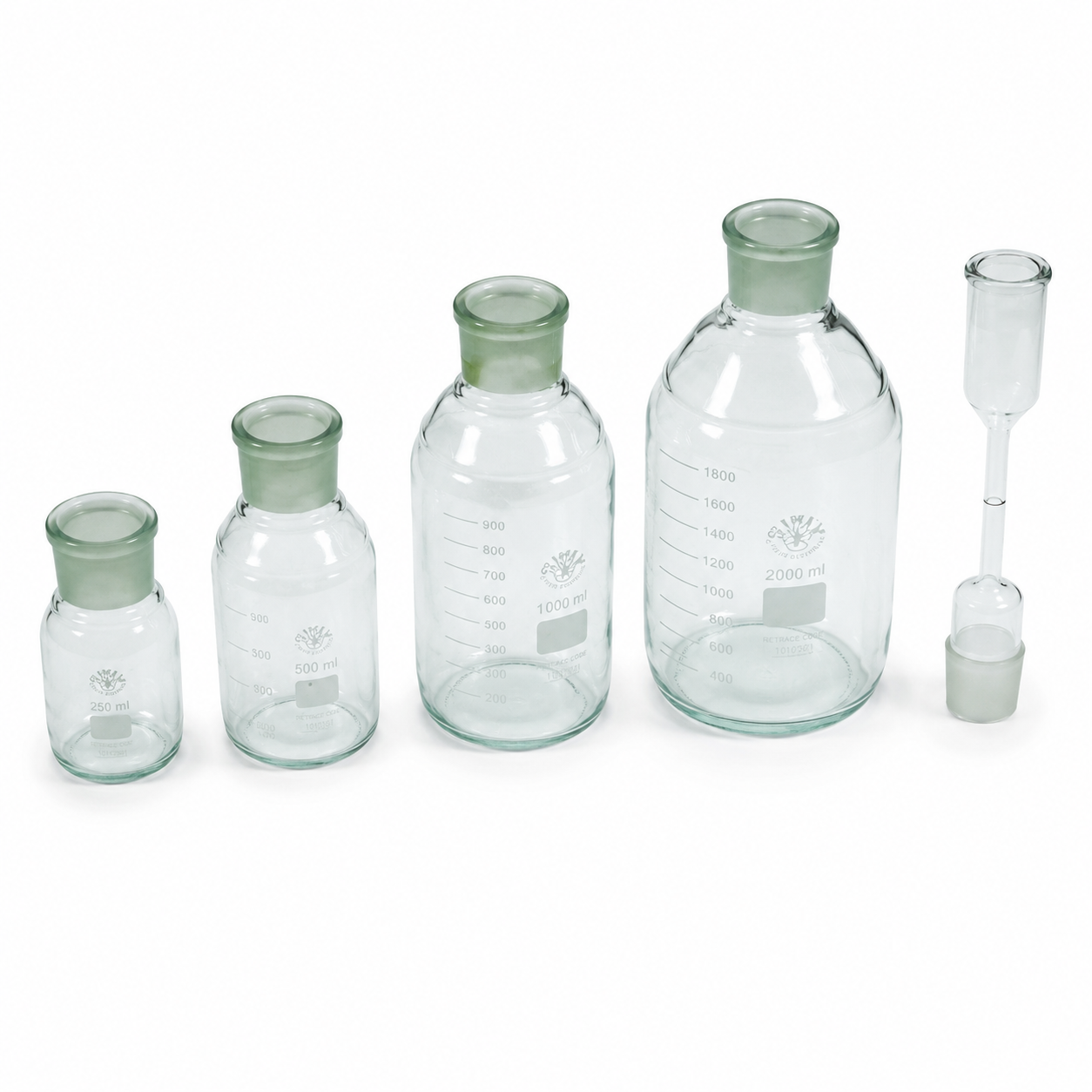
Bottle Type Pycnometers are used to determine the particle density and water absorption of aggregate samples. The transparent glass body allows the operator to monitor the water level and trapped air bubbles during testing. Different volume options make it possible to select a suitable pycnometer according to the aggregate sample quantity.
- Aggregate Particle Density: Supports determination of particle density using the known pycnometer volume.
- Water Absorption Testing: Helps determine the amount of water absorbed by aggregate particles.
- Available Capacities: 500, 1000, 2000, 3000 and 5000 ml
- Transparent Glass Body: Allows direct observation of the sample, water level and trapped air.
- Ground Glass Neck: Provides a precise connection between the bottle and filling head.
- Controlled Filling: Special glass filling head helps achieve a consistent water level.
- Different Sample Volumes: Suitable for both small and large aggregate samples.
- Easy Cleaning: Wide glass body and removable filling head simplify cleaning after testing.
- Laboratory Application: Suitable for aggregate testing and construction-material laboratories.
- Standard: EN 1097-6
| Product Code | Product Name | Dimensions (mm) | Weight (kg) |
| LT-G0070 | Bottle Type Pycnometer, 500 ml | 100 × 100 × 170 | 0.7 |
| LT-G0071 | Bottle Type Pycnometer, 1000 ml | 150 × 150 × 270 | 1 |
| LT-G0072 | Bottle Type Pycnometer, 2000 ml | 180 × 180 × 350 | 1.25 |
| LT-G0073 | Bottle Type Pycnometer, 3000 ml | 250 × 250 × 340 | 1.35 |
| LT-G0074 | Bottle Type Pycnometer, 5000 ml | 250 × 250 × 400 | 1.6 |
| LT-G0114 | Glass Filling Head for Bottle Type Pycnometer, Ground Joint | 50 × 50 × 275 | 0.2 |

LT_PİKNOMETRE_
What Is a Bottle Type Pycnometer?
The Bottle Type Pycnometer is used to determine the particle density and water absorption of aggregate samples. During the test, the operator places a known mass of aggregate into the pycnometer and fills the bottle with water. The required mass measurements are then used to calculate the density characteristics of the aggregate.
Particle density provides information about the volume occupied by aggregate particles. This information is important for volumetric calculations in concrete, mortar and asphalt mixture design. Water absorption results also help laboratories evaluate the moisture behaviour of aggregate materials.
Different Volume Options
LİYA Test offers Bottle Type Pycnometers in 500, 1000, 2000, 3000 and 5000 ml capacities.
The operator can select the appropriate model according to the quantity and particle size of the aggregate sample. Smaller models provide practical handling for limited sample quantities, while larger bottles offer additional working volume for higher-capacity aggregate testing.
Selecting a suitable bottle size also helps the aggregate move freely during air-removal and filling operations.
Transparent and Durable Glass Body
The transparent glass construction allows the operator to observe the complete testing process.
Air bubbles trapped between aggregate particles can be easily detected through the clear body. This is important because trapped air can influence volume measurements and reduce the accuracy of the calculated result.
The glass body also allows the water level to be monitored during filling.
A ground glass neck provides a precise connection with the filling head. The removable glass filling head helps the user bring the liquid to a consistent reference level.
How Is a Pycnometer Test Performed?
First, the operator cleans and dries the pycnometer and records its mass.
The prepared aggregate sample is then placed inside the bottle. Water is gradually added to cover the material. The operator carefully agitates the pycnometer to help remove trapped air from between the aggregate particles.
After the trapped air has been removed, the bottle is filled to the required reference level. The outside of the pycnometer is dried before the final weighing operation.
Water temperature should be monitored because density varies with temperature. The balance should also be checked before each weighing operation.
Particle Density and Water Absorption
The measured masses allow the laboratory to calculate different aggregate density values.
Depending on the test procedure, these may include oven-dry particle density, saturated surface-dry particle density and apparent particle density.
Water absorption can also be calculated by comparing the dry and saturated conditions of the aggregate.
These values help quality-control laboratories compare aggregate sources and evaluate materials before their use in concrete or other construction products.
Testing According to EN 1097-6
EN 1097-6 specifies methods for determining the particle density and water absorption of aggregates. Pycnometer methods are included for applicable aggregate size fractions.
The Bottle Type Pycnometer provides a transparent, reusable and practical laboratory vessel for carrying out these measurements.
As a result, the product range combines multiple capacities, clear glass construction and controlled filling to support reliable and repeatable aggregate density and water absorption testing.